Estate Planning for Investors · Part 1
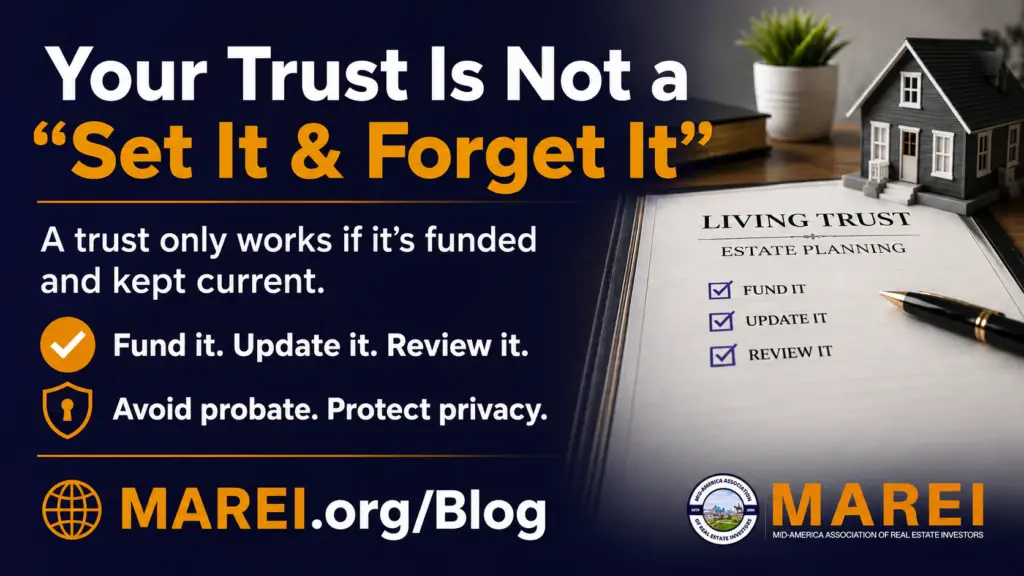
Your Trust Is Not a “Set It and Forget It”
Ask the average person if they’ve got their affairs in order, and they’ll tell you they have a will.
And most of you reading this already know what that’s worth. A will feels like a plan. It mostly isn’t. Because whatever your will says, it says it on the way to the same place: probate court. What actually keeps you out of that mess is a revocable living trust — and setting one up is exactly where most investors stop short.
Quick word on probate
Probate is the court process that settles your estate after you’re gone, and it’s got three problems. It’s slow — months, sometimes more than a year before anyone can act. It’s expensive — the fees come out of what you meant to leave behind. And it’s public — anybody can pull the file and see everything you owned, what it was worth, and who got it. For an investor, that last one should make you wince. Your whole portfolio, on the record, for your tenants and your competition to read.
A will doesn’t spare you any of that. A will is just your note to the probate judge.
What you actually need
You’ve got three tools. Most of you know the shape of them already, so I’ll keep it quick.
A will — cheap, simple, goes through probate. The wrong lead tool once you own more than a house.
A beneficiary or transfer-on-death deed — skips probate on one specific property. Handy, narrow, no real control.
A revocable living trust — the one worth building around. And the one worth actually understanding, because this is where people think they’re finished when they’ve barely started.
What a revocable living trust really is
Think of it as a box you own and control. You move your assets into the box while you’re alive. You can open it, change it, add to it, take from it, any time you want — that’s the “revocable” part. Nothing about your day-to-day changes. But when you die, or you’re hurt and can’t act, the person you named just picks up the box and hands things to your heirs. No court. No delay. No public file.
Set up and funded correctly, a trust:
- Keeps your estate out of probate entirely
- Passes your property to your heirs directly, on your terms
- Keeps the whole thing private — nobody gets to read your business
- Lets a successor step in immediately if you’re incapacitated, not just deceased
- Makes creditors work harder, since your name isn’t on the assets
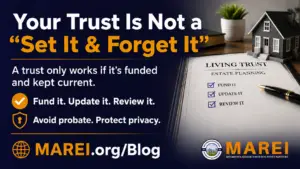
Every promise on that list rides on two words sitting in front of it: and funded. Skip that step and the whole list is just a wish.
Here’s where it falls apart
Most people treat a trust like a crockpot. Set it, forget it, dinner’s handled. It isn’t. Three reasons.
1. You have to fund it. This is the one that sinks people. A trust only controls what’s actually inside it. Sign the trust and never move your assets in, and the properties are still in your name, the LLCs are still in your name — so when the day comes, it’s straight to probate, the exact thing you paid to avoid. Funding means retitling: deeds moved into the trust, LLC membership interests assigned to it, accounts pointed at it. And going forward, it means buying your next deal with the trust in mind from day one — not “I’ll fix the title later.”
2. Things change. You buy. You sell. You refinance. You spin up an LLC, close another, take on a partner. Family changes too. A trust you funded perfectly two years ago is already out of date if you’ve bought three properties since. It has to keep pace with the business you’re actively running.
3. We get 1 and 2 wrong. Even careful people miss a deed, forget an account, or assume the title company handled it. (They didn’t.) Which is why a trust isn’t a document you file away and cross off — it’s a system you check on, ideally with someone who knows where investors trip.
Which is exactly why we’re doing September 8
Here’s my honest read on where most of you are. You already know you need a trust. What’s missing isn’t the why — it’s the motivation to get it built, the follow-through to actually fund it, and a real picture of everything “funding and implementation” involves.
That’s the whole point of the September 8 MAREI meeting. And the other thing you carry into every deal from here on isn’t just “is this trust current” — it’s “what does this do to my taxes, and my heirs’ taxes.” Trust and taxes, riding in the back of your mind on every investment going forward. That’s the habit we’re really trying to build.
Mark Your Calendar
September 8 · MAREI Meeting
Two experts, the two halves of the plan — the legal structure and the tax strategy.


And even all of that only settles who gets your business. It doesn’t settle who could run it if you couldn’t. That’s a different problem — and it’s where we’re headed next time.
Frequently Asked Questions
Does a revocable living trust avoid probate?
Yes — but only for the assets actually titled in the trust’s name. An unfunded trust avoids nothing.
What does it mean to “fund” a trust?
Moving your assets into it: retitling property deeds into the trust, assigning your LLC membership interests to it, and pointing accounts at it. Signing the document is step one, not the finish line.
Should I put my rental properties or LLCs in my living trust?
Usually the trust owns your LLC interests (not the properties directly), so the LLC keeps its liability protection while the trust handles succession. Confirm the structure with your attorney — it’s exactly what we’re covering September 8.
What happens if I don’t fund my trust?
Your assets stay in your personal name, so when you pass they go through probate anyway — the slow, public, costly process the trust was supposed to spare your family.
How often should I review my living trust?
At least once a year, and any time you buy, sell, refinance, form or close an entity, or have a major family change. A trust has to keep pace with an active portfolio.
I’m not an attorney and this isn’t legal advice — it’s the nudge to go get some. A lot of the thinking here comes from Mick McGirr of Phocus Law, by way of our friends over at AZREIA.