Featuring insights from CPA & Chief Tax Strategist Scott Ellsworth
If you’ve ever felt like taxes are the part of real estate investing you’d rather pretend doesn’t exist… you’re not alone. Most investors love the deals, the hunt, the strategy — but the paperwork, the bookkeeping, the planning? Not so much.
IRS Red Flags Most Investors Miss (And How to Fix Them Before Year-End)
That’s exactly why I want you to hear this conversation with CPA and investor Scott Ellsworth. 👉 Hit play on the MP3 above — it’s worth every minute.
Scott breaks down the stuff most investors never get told until it’s too late: the habits that get you in trouble, the timing decisions that save you thousands, and the year-end moves that can completely shift your tax bill.
And yes — we even talk about the IRS red flags that real estate investors trip over all the time.
The Most Common Red Flag? It’s the One You Probably Don’t Notice.
Scott and host Tiffany Ray kick things off by talking about the biggest issue: Poor (or nonexistent) recordkeeping.
As Scott puts it:
“Everyone loves doing deals. Nobody loves doing accounting. But if you don’t know where you are, you can’t plan — and it costs people real money.”
Mileage, receipts, equipment purchases, timing your income… none of that matters if your books are a shoebox full of guesses. And according to Scott, that’s the #1 reason investors miss big opportunities.
Why Timing Matters More Than Your CPA Tells You
One of the most valuable insights in this interview:
You can legally shift your income and expenses between this year and next year — if you know your bracket.
If you’re heading into a higher bracket next year, Scott says you might want the income this year. If next year will be slower, you may want to defer the income and load deductions into the higher-bracket year.
Small shifts make big financial differences — but only if your books are up to date.
Bonus Depreciation, Cost Seg, and Opportunity Zones — Oh My.
Scott covers some advanced topics too, but don’t let that scare you. Here’s the bottom line:
✔️ Bonus depreciation still exists — and you can use it with the right planning. ✔️ Cost segregation can unlock first-year deductions equal to 15–25% of the building you bought. ✔️ Opportunity Zones aren’t talked about enough — and the new legislation made them even better.
He explains them all in plain English inside the audio.
One Thing Every Investor Should Have Before December 31
Scott is clear about this:
“If you had your druthers, you’d have a system — and you’d actually use it.”
QuickBooks. Stessa. REI-focused bookkeeping services. Whatever you choose, it should help you do three things:
Track expenses in real time
Separate business from personal spending
Know your numbers before the year is over
(And yes — you’ll hear him roast anyone whose expenses “all end in .00.” The IRS notices that too.)
Want to Learn This Stuff the Right Way? Join Us December 13th.
If you found even one helpful nugget in this conversation, you are exactly who needs to be at our upcoming workshop.
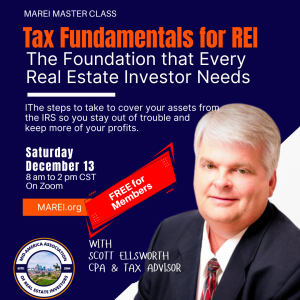
Tax Fundamentals Master Class
Saturday, December 13th — 8:00 AM to 2:00 PM CST Instructor: Scott Ellsworth, CPA & Investor FREE for MAREI Members RSVP → MAREI.org/calendar
Scott will break taxes down for real estate investors in a way that actually makes sense:
✔️ How to avoid IRS red flags ✔️ The difference between earned, passive, and portfolio income ✔️ Year-end strategies most investors miss ✔️ How to use cost segregation and retirement accounts to build long-term wealth ✔️ The smartest deductions to take — and which ones to avoid
If you’re investing in real estate, this class will save you stress, money, and headaches.