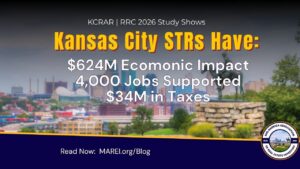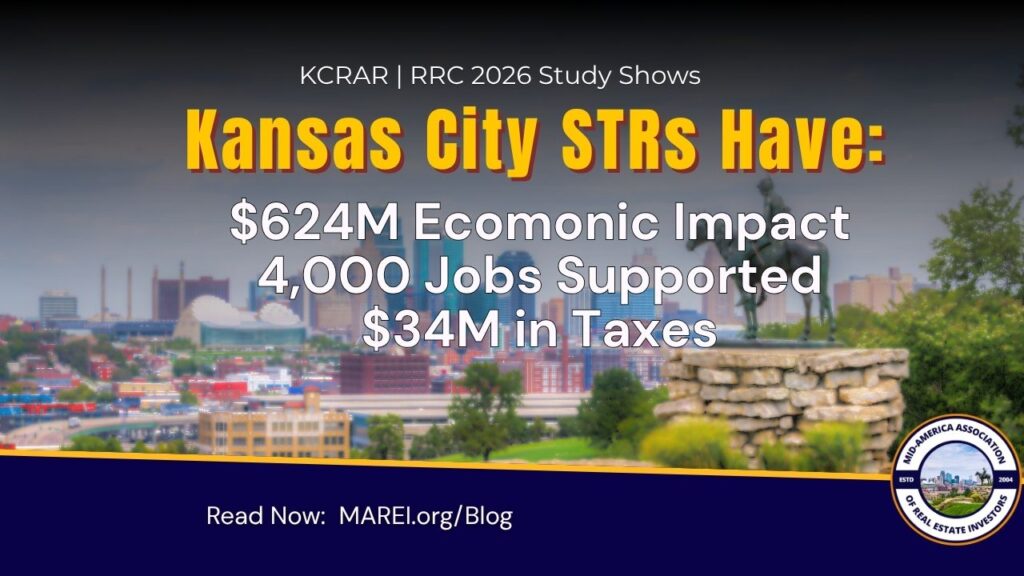
A major new study finds Kansas City short-term rentals are contributing meaningfully to the local economy — and are not driving housing costs. Here's what every KC real estate investor needs to know.
A landmark study on Kansas City short-term rentals (STRs) has delivered findings that should matter to every real estate investor, property owner, and housing policy advocate in our region. The bottom line: STRs are contributing meaningfully to our local economy, and the data does not support the claim that they are driving up housing costs.
The study was conducted by RRC Associates and commissioned by the Kansas City Regional Association of REALTORS® (KCRAR) — with support from Missouri REALTORS®, Kansas REALTORS®, and the National Association of REALTORS®. It is one of the most comprehensive analyses of the STR market ever conducted for the Kansas City region. MAREI extends sincere thanks and kudos to KCRAR for taking on this important research and making it publicly available.
📄 Download the Executive Summary
📄 Download the Full Report
The Kansas City STR Market: Bigger Than You Might Think
The study covers the six-county Kansas City metro area — Clay, Jackson, and Platte counties in Missouri, and Johnson, Leavenworth, and Wyandotte counties in Kansas. As of March 2026, the region had 4,370 active STRs capable of accommodating up to 24,653 guests — a 125% increase since January 2019. That growth reflects real traveler demand and real opportunity for local property owners.
And who are these STR operators? Largely, they're your neighbors. Nearly 90% of STRs are owned by individuals or entities based right here in the Kansas City metro area, and 95% of operators own just a single STR property. This is not a market dominated by faceless corporations or institutional investors — it's local people making local investments.
The Economic Impact Is Real and Substantial
Critics of STRs often focus on perceived negatives while overlooking the tangible economic contributions these properties make. The numbers from this study are significant:
Kansas City metro STR economic impact, 2025
Economic output
$624M
Jobs supported
4,000
GDP contribution
$383M
Labor income
$157M
Tax revenue
$34M
Source: KCRAR / RRC Associates, 2026
Kansas City short-term rentals now account for approximately 11% of the combined lodging inventory in the metro. The study found that STRs and hotels largely function as complementary components of the lodging ecosystem — serving different traveler needs — rather than direct competitors.
KC metro lodging inventory — March 2026
Hotel rooms
89% 36,503 rooms
Short-term rentals
11% 4,370 units
STRs complement rather than replace hotel capacity
Source: Lighthouse / CoStar / RRC Associates, 2026
Are Kansas City Short-Term Rentals Hurting Housing Affordability?
This is the question at the center of virtually every STR policy debate, and it's the one the KCRAR study addresses most directly. The answer, backed by data, is no — not in any meaningful, measurable way.
STRs Are a Tiny Slice of the Housing Market
As of 2024, STRs represented just 0.4% of total housing stock across the six-county region — roughly one STR for every 243 housing units. That figure is consistent with comparable Midwestern metro markets studied.
Share of total housing stock — KC metro, 2024
All other housing
99.6%
Short-term rentals
0.4%
1 STR per 243 housing units
Source: KCRAR / RRC Associates / US Census, 2026
No Statistical Link to Rising Home Values or Rents
The study's statistical analysis found no significant relationship between municipal STR density and average home values or rents. Rising housing costs in Kansas City occurred uniformly across municipalities — regardless of whether they had high or low concentrations of STRs. The data points to broader economic forces as the real drivers: rising interest rates, pandemic-era demand surges, and a construction slowdown ongoing since the Great Recession.
Housing Costs Rose Before STRs Even Took Off
The study found that increases in housing costs were generally concurrent with — or slightly ahead of — the most rapid period of STR growth. The horse came before the cart.
Even Strict Regulations Didn't Bring Housing Relief
When Kansas City, MO implemented stricter STR regulations in June 2023, local STR counts dropped noticeably. But home values and rents kept climbing at roughly the same rate as everywhere else in the metro. If STRs were the primary culprit behind unaffordability, we'd expect relief after regulation. The data show none.
What the KC Short Term Rental Alliance Is Saying
Susan Brown of the KC Short Term Rental Alliance (KCSTRA) highlighted these key takeaways from the study:
"STRs have grown ~125% since 2019, supporting ~4,000 jobs and generating ~$624M in economic output in 2025."
"STRs account for only ~0.4% of total housing stock across the metro — and the study found no significant relationship between STR density and home prices or rents. Broader market forces are the primary drivers."
"Residents generally recognize the economic benefits of STRs and favor thoughtful, well-enforced regulations over overly restrictive measures."
KCSTRA's reading of the data aligns with what MAREI has long believed: STR operators are a vital part of the Kansas City real estate ecosystem, and policy should follow the evidence.
What KC Residents Actually Think
The study included a community survey of Kansas City metro residents. The results were nuanced — and encouraging for STR advocates.
What KC residents think about vacation rentals
n=326 | KC metro community survey, 2026
Source: RRC Associates — 2026 Kansas City Metro Community Survey
Perhaps most importantly, residents broadly favored a regulated STR market with clear standards and enforcement — not an outright ban, and not a complete free-for-all. Support was strongest for permitting requirements, occupancy standards, and neighborhood impact mitigation. Residents were least supportive of measures that could raise taxes or cut public services for full-time residents.
What This Means for MAREI Members
For MAREI members who own or are considering Kansas City short-term rentals, this study provides important validation — and useful data for policy conversations:
- The economic case for STRs is strong. Jobs, tax revenue, GDP contribution — the numbers are real and substantial.
- The housing affordability argument against STRs doesn't hold up to scrutiny in the Kansas City market. Broader supply-and-demand dynamics, interest rates, and construction constraints are the real drivers of housing costs.
- Balanced, reasonable regulation is the community sweet spot. Engaging constructively in local regulatory discussions — rather than opposing all regulation — is the most effective long-term strategy.
- Local ownership is a strength. With 95% of STR operators owning a single property, this is a grassroots, community-embedded industry — not an extractive outside force.
The Bottom Line
The KCRAR/RRC study is the most data-driven look at Kansas City short-term rentals to date, and its conclusions should reshape the policy conversation. STRs are contributing to our economy, supporting local jobs, generating tax revenue, and providing lodging options that travelers want — all while having no measurable negative impact on housing costs.
That's a story worth telling. And a big thank you to KCRAR for doing the rigorous work to tell it.
📄 Read the Executive Summary
📄 Read the Full Report
MAREI — Mid-America Association of Real Estate Investors — serves real estate investors across the Kansas City metro and surrounding region. For more information, visit MAREI.org.

Short Term Rentals
Many thanks to KCRAR for completing this study
Visit website: KCRAR.com