George Antone has been quietly changing the way serious investors think about money for 20 years. Here is what he teaches — and why it matters right now.
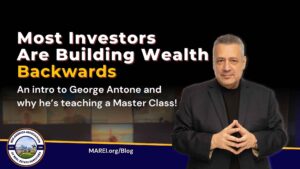
▶ WATCH FIRST: George Antone — Most Investors Are Building Wealth Backwards
In this short video George walks through why asking “what should I buy?” is the wrong first question — and what to ask instead.
If that video made you stop and think — good. That is what George Antone does.
He has a way of asking the one question you have not been asked: Are you building wealth in the right order? Not the right assets. Not the right market. The right order. For a lot of experienced investors, that question lands hard.
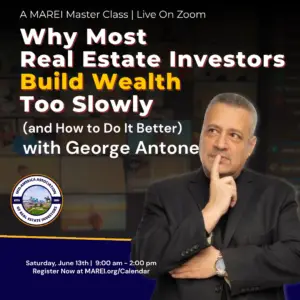
📅 George Antone Is Teaching a Live Class for MAREI — June 13th
This is a nationwide online master class hosted across 10+ investor groups. Experienced investors from multiple markets are already registered.
MAREI Members: $47 · Non-Members: $97 (through June 11th)
All registrants receive the recording. 100% money-back guarantee.
"I am an accountant, CPA, and long-time real estate investor, and I still didn't really understand how money REALLY works until I met George. Thanks to following his systems, I'm confident that not only will I live out my life in comfort, but I'll leave a real legacy, too."— Jerry Fink CPA, real estate investor, and leader at the Cincinnati Real Estate Investors Association
Who Is George Antone
George Antone is a three-time bestselling author (The Banker's Code, The Wealthy Code, The Debt Millionaire), co-founder of the world's largest private lender network, and creator of Fynanc — a financial education company he has built over 20 years working with tens of thousands of investors across the country.
Before all of that, he was a Lead Software Developer at Intuit — the company behind QuickBooks and TurboTax. He spent his days inside the architecture of financial software. What he saw there stopped him cold: the conventional investing strategies most people follow are mathematically structured to ensure they never fully reach their goals. Not because the strategies are wrong — because they are applied in the wrong sequence.
That realization changed his career. His entire body of work since then has been built around one question: why does wealth building take so much longer than it should — and what changes when you understand the actual rules?
▶ WATCH: The Source Code — What George Found Inside Intuit's Software
George tells his own origin story in his own words.
The Three Types of Money — And Why Mixing Them Up Costs You Years
George teaches that money serves three fundamentally different purposes depending on where you are in your wealth journey. Most investors are using strategies from the wrong category — and that mismatch is the single biggest reason experienced investors feel financially stuck despite doing everything right.
Capital actively deployed to create velocity and momentum. The goal is speed, not stability. This is the phase where leverage is your most powerful tool and capital efficiency matters more than asset appreciation. If you are in this phase, your money needs to be moving fast.
Capital positioned in assets for medium-term income and appreciation. Rentals, notes, and income-producing assets make increasing sense here — but only once you have the financial foundation to deploy them efficiently. Arriving at this phase too early is one of the most common mistakes active investors make.
Capital protected from loss, focused on maintaining and passing on what you have built. Long-term paid-off rentals, conservative assets, estate planning structures belong here. Slow, steady, and safe is exactly the right answer — but only if you have already built enough wealth worth preserving. Arriving here too early means guarding a smaller pile than you could have built.
Every investor needs all three. The question George forces you to answer is this: do you know which phase your capital is actually in right now — and is your strategy genuinely matched to that phase?
For most active investors, the honest answer is no. They have money in all three buckets with no framework connecting them. George calls that drag a financial bottleneck — wealth that builds, but more slowly than it should.
Velocity of Money — The Concept That Changes How You See Every Deal
Velocity is how efficiently and quickly your capital moves through your investment system. A dollar sitting in paid-down equity is not moving. A dollar actively deployed — generating returns, cycling back, getting redeployed — is moving fast. The difference in what those two dollars produce over ten years is enormous.
Here is where it gets specific for Kansas City investors.
A fully paid-off rental feels like a win. And eventually it is. But consider what you actually have: equity locked in an illiquid asset, generating modest cash flow. That equity cannot be easily redeployed. It has very low velocity.
Compare that to a property with strategic leverage — say 70% LTV with a well-structured loan. The equity you preserved in the first scenario is now deployed in two or three additional deals. That capital is producing returns in multiple places simultaneously.
What is a loan constant? The loan constant is your annual debt service divided by the original loan amount. It tells you how much of your gross income goes toward debt per dollar borrowed. A lower loan constant means your debt costs less relative to what you borrowed — more of your income stays in play. George teaches investors to watch this number, not just the interest rate, because it captures both rate and amortization together and gives a truer picture of how much drag your debt is creating.
This is not an argument for reckless leverage. George is clear about the importance of reserves, loan-to-value discipline, and managing your spreads — the difference between what your money earns and what your debt costs. The argument is for intentional leverage, calibrated to your phase.
The Rental Question That Makes KC Investors Uncomfortable
We are a rental-heavy market. Buy, hold, cash flow, pay down the mortgage, build equity over 20 years — that is the plan most KC investors are running. George respects it. He does not tell you to stop.
What he asks is: when did you start?
If you loaded up on long-term buy-and-hold rentals early in your journey — before you had significant capital velocity — you may have spent years building equity in places that are not efficiently contributing to your wealth creation phase.
A 30-year paid-off rental is a great wealth-preservation tool. It is a slow wealth-creation tool. If preservation is the right phase for you right now, it is exactly right. If creation is the right phase, you may have arrived at preservation 15 years early.
George also makes a counterintuitive point about mortgage structure. A 15-year mortgage feels more responsible. But the loan constant on a 15-year is significantly higher than a 30-year — you are committing more of your gross income to debt service, which reduces your capital velocity. In many cases, especially in the growth phase, a well-structured 30-year preserves the capital efficiency that a 15-year eliminates. What matters is not how fast you pay off the debt — it is what you do with the capital you free up by not paying it off faster.
This is the kind of idea that annoys people at first. Then they run the numbers on their own portfolio.
Why "What Should I Buy?" Is the Wrong Starting Question
Most investors start by asking what asset to buy. George teaches that this is backwards.
The asset is not the starting point. The capital is. The structure is. The sequence is.
When you lead with the asset — "should I buy a rental in Independence or flip in Overland Park?" — you are skipping more important questions: What phase of wealth building am I in? What is the velocity of my current money? What strategy is right for this phase?
George uses a framework he calls the Capital Amplifier — a six-component system mapping how money flows through your investment life: capital, strategies, portfolio, flow, liquidity, and control. Most investors are almost entirely focused on the portfolio component — the assets — while underinvesting attention in the components that determine whether those assets are actually building wealth efficiently.
Skipping to the middle of that sequence — going straight to "what should I buy" — is why so many experienced investors have solid portfolios and still feel financially stuck.
"It's hard to describe how much learning from George has affected me and my family. We went from worrying that everything we built could disappear to having clarity, control, and a clear path toward wealth building. We play the money game with far more confidence and less stress than we used to."— Sam Warf Real estate investor and leader at the Real Estate Investors of Nashville
He Is Teaching a Live Class for MAREI — June 13th
On June 13th, George is teaching a live half-day master class on Zoom. MAREI is one of more than ten real estate investor groups across the country hosting access to this class simultaneously. Serious, experienced investors from multiple markets are already registered — people who specifically know George's work and are showing up to go deeper.
The class runs 9:00 AM to 2:00 PM Central and includes live breakout rooms where you work on your own investment plan during the session. The recording is included for all registrants — but the hands-on work happens live.
If reading this made you ask "wait, am I in the wrong phase right now?" — that is exactly the question this class is built to answer, for your specific situation.
Register — George Antone Master Class, June 13th
Why Most Real Estate Investors Build Wealth Too Slowly
Saturday, June 13, 2026 · 9:00 AM – 2:00 PM Central · Online via Zoom
MAREI Members: $47 through June 11th · $67 after
Non-Members: $97 through June 11th · $127 after
MAREI membership is $25/month — join and attend for less than the non-member price.See Join Now at the top for more on membership
Express Success Coaching Students: Free — watch your inbox.
All registrants receive the full recording. 100% money-back guarantee.
"The books are only a light intro to what George Antone has to offer. If you take it and apply it, not only will your life change — so will your family's future."— Sam Warf MAREI member and leader at the Real Estate Investors of Nashville
MAREI — Mid-America Association of Real Estate Investors · Serving the Kansas City Metro Since 2004
MAREI.org · 913-815-0111 · [email protected]

George Antone
Articles based on videos provided by George Antone