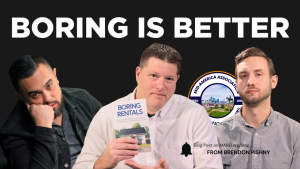
If you’ve ever felt pulled toward real estate—but turned off by the “hustle,” risky flips, or guru hype—this episode is a breath of fresh air.
In this podcast conversation, Kansas City–area investor and MAREI Mentor Brendon Pishny shares how he built a rental portfolio the boring way: steady purchases, disciplined reinvestment, and a focus on neighborhoods he knows.
Watch the full episode here:
Based on Brendan Pishny's appearance on the Entrepreneur Experience podcast.
You've probably met Brendan at MAREI or one of the many other events on our calendar. He can quite often be found attending and discussing real estate with members across the metro. He's found success with rental properties and he is always seeking to give back, by helping others as he was helped when he was getting started.
Brendan didn't start out with a master plan.
He graduated college with an agriculture degree, moved to Kansas City, got married, had kids, and took a job with a lawn care company. It paid the bills — barely. With three kids and daycare eating up most of his paycheck, he was exhausted, unfulfilled, and quietly miserable. His wife noticed. He noticed that she noticed. Something had to change.
What followed wasn't a dramatic pivot so much as a single decisive leap. Within two weeks of deciding to try real estate, Brendan had asked his parents for help with financing, hired an agent, and put his first property under contract. No MBA. No mentor. No spreadsheet model. Just a gut feeling that if he didn't jump, he never would.
Thirteen years later, he owns 17 properties across the Kansas City suburbs — and he just published his first book.
The Minivan of Real Estate
Brendan has a name for his investment strategy, and it's not glamorous by design.
"Rental properties are the minivan of real estate. They're boring, plain, everybody's got one — but they get the job done."
It's a contrast he makes deliberately. Flipping properties is the red sports car: exciting, photogenic, the stuff of HGTV. Rentals don't make television. Nobody's doing a show about collecting rent on a three-bedroom in Olathe. But while the flippers are chasing the next deal, the buy-and-hold investor is quietly building equity, depreciating assets, and watching cash flow grow year over year.
That boring consistency is exactly the point. As Brendan puts it in his book, Boring Rentals: Build Wealth, Experience Freedom, and Find Purpose One Rental Property at a Time: rentals are slow and steady. They build wealth gradually and consistently. And that's okay.
Build in Your Own Backyard
One of Brendan's core principles is deceptively simple: stay close to home.
All 17 of his properties are in the Kansas City suburbs, almost all on the Kansas side, and nearly all within 20 to 25 minutes of where he lives. He's not chasing higher cap rates in markets he doesn't know. He's investing in communities he understands, drives through, and actually cares about improving.
For newer investors tempted by out-of-state deals or "better" markets, Brendan's advice is a gentle counterpoint. You know your backyard. You know what's appreciating, what the tenant pool looks like, and what a fair rent is. That local knowledge is an edge most people undervalue.
The BRRRR Before It Had a Name
Brendan was essentially doing BRRRR — Buy, Rehab, Rent, Refinance, Repeat — before the acronym became a staple of real estate investing conversations. His early approach was to find distressed properties well below market, put rehab money in, place a tenant, and eventually refinance to pull capital back out and redeploy it.
He also leaned on creative financing: seller financing, buying significantly under market value, and DSCR loans — debt-service coverage ratio loans that qualify borrowers based on the rental income a property can generate rather than a W-2.
"The challenge is finding the lending. As entrepreneurs, we don't have W-2 jobs. And banks really like W-2 jobs. So you have to learn how to pivot into whatever tools are available to help you grow."
For investors who've run into the same wall, DSCR loans have changed the equation significantly. The approval is based on the asset, not the borrower's income — a meaningful shift for anyone building a portfolio outside traditional employment.
Systems Make the Difference
Ask Brendan what changed his business more than anything else and he won't point to a deal or a market shift. He'll point to property management software.
He uses Buildium, a platform designed for larger management companies that he's adapted for his own portfolio. Tenants get a portal to pay rent and submit maintenance requests. He tracks everything in one place. The chaos of paper systems and missed calls has been replaced by something that actually scales.
That said, Brendan is candid that he learned this the hard way. In the early years he let property management run him rather than the other way around. Reactive, stressed, phone always on. Now he operates with boundaries, a defined process for handling requests, and the recognition that true emergencies are far rarer than they feel.
He's also planning to take the next step in 2026: handing some of the management off entirely. His reasoning is worth repeating for any investor who's stalled on buying more.
"If you have somebody else managing it for you, and you know it's not going to be on you — buying a property gets exciting again."
Cash Flow, Appreciation, and the Long Game
Brendan targets roughly $400 per door in monthly cash flow when underwriting a new purchase. It's not a rigid rule — some properties carry no mortgage, others have HOA fees that compress margins — but it's a working benchmark that lets him evaluate deals quickly.
More importantly, he distinguishes between two types of markets: those that cash flow well and those that appreciate strongly. He's built his portfolio in higher-appreciation areas, accepting slightly thinner monthly margins in exchange for long-term equity growth. For investors whose primary goal is to replace W-2 income quickly, he acknowledges that higher cash flow markets — often a bit rougher around the edges — may make more sense.
The key, he says, is knowing what you're solving for. His personal target is 20 doors — not because it's a round number, but because at that scale the cash flow from his portfolio would cover everything he'd ever need. He doesn't measure in doors so much as in what those doors produce — a distinction that matters when comparing portfolios across property types and debt loads.
Why He Wrote the Book
Brendan spent years thinking about writing a book on real estate and talking himself out of it. Everything worth saying had already been said. What could he possibly add?
A friend who had written a book on marriage stopped him cold with a single line: "That may be true — but they haven't heard it from your perspective."
That reframe was enough. Brendan's book isn't trying to compete with the biggest names in real estate publishing. It's written for the person who picks up a popular real estate book and feels like it's aimed at someone already ten levels ahead of them. It's for the investor who just wants one or two properties, or who isn't sure real estate is even for them, and needs someone a few steps ahead — not someone operating at a scale that feels like science fiction.
The book is organized around three phases:
- Getting started — finding your why, funding purchases, finding deals
- Building momentum — growing your portfolio, managing properties, using debt wisely
- Planning for the endgame — financial goals, estate planning, leaving a legacy
Boring Rentals is available on Amazon in both print and Kindle formats. Search Brendan Pishny.
The Real Point
Strip away the strategy and the systems and the metrics, and what Brendan is really talking about is purpose. He was miserable in his lawn care job — not dramatically, not in crisis, but quietly and steadily in a way that was affecting his family. Real estate didn't just fix his finances. It gave him something to care about and get good at.
That's the message underneath the boring rentals framework. Find the thing that actually engages you. Build something that lasts. Show up at the community events. Help the next person the way someone helped you.
The wealth follows. But it's not really the point.
Brendan Pishny's book, Boring Rentals, is available on Amazon. He can be found at local real estate events across the Kansas City metro.
Buy the book or read it for free with Kindle Unlimited: Click Here for MAREI’s Amazon Affiliate Link
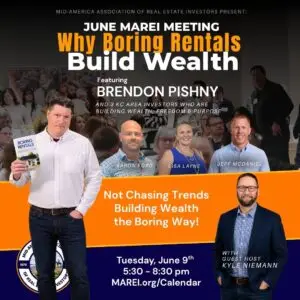
And if you have questions, bring them to the Next MAREI meeting. There’s a good chance you will find Brendon there.
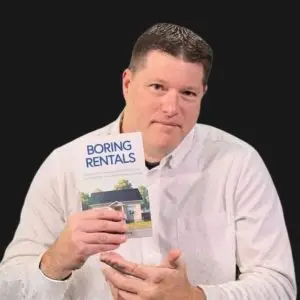
Brendon Pishny
Local KC Metro Real Estate Investor, MAREI Mentor, and former president of Johnson County Landlords