Estate Planning for Investors · The Operating Side
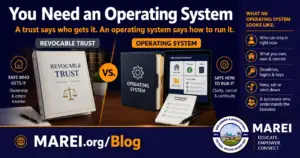
You Don't Just Need a Trust. You Need an Operating System.
We spend our whole investing lives planning the next deal. We almost never plan for the one day the deals have to run without us.
Not the day you sell. The day you can't.
That day shows up in different ways. Sometimes it's sudden — a car wreck, a stroke, a heart attack — and you're either gone, or you're still breathing but you can't sign, can't decide, can't tell anyone where anything is. Other times it comes on slow — an illness that takes your judgment a little at a time, so gradually that by the time everyone admits what's happening, the damage is already done.
Here's the hard part: a will and a trust don't really cover any of it. They decide who gets your business. They say nothing about who can run it — and whether that person has the first idea how.
Let me tell you about two investors who learned that the expensive way.
When it's sudden
The first built a portfolio of 25 houses with his wife — about $2.1 million, all of it meant for their young daughter's future. Then came a divorce, and not long after, his sudden, unexpected death. He'd always figured he had years to get the paperwork sorted. Someday.
I don't know whether he had a will or a trust. What I do know is that he didn't have a single person who knew how to run 25 rentals. The estate landed with an attorney — a competent attorney, but one who settles estates, not one who manages tenants, turns units, or knows a good roof from a bad one. The houses got appraised at the full $2.1M and marketed as one take-it-all package. For two years, that package sat.
Two years is a long time for a house to sit. By the end, only two or three still had tenants. The rest had stacked up deferred maintenance, and the empty ones drew vandalism. The portfolio that appraised at $2.1 million finally sold for around $300,000 — and the attorney's fees came out of what was left.
I know exactly how that story ends, because I'm the one who bought the estate.
A $1.8 million legacy, gone in 24 months. Not to the market. Not to taxes. To the plain fact that nobody was in place who knew how to run the business.
When it's gradual
The second story is worse in a way, because he saw it coming and still couldn't stop it.
Vena Jones-Cox — a well-known investor and educator — has told the story of her father, who spent 40 years building a real estate empire: roughly 100 apartments and 150 houses, somewhere around $5 million. Then Alzheimer's set in.
It didn't take his properties overnight. It took his judgment, slowly. Decisions got inconsistent. Maintenance slipped. Vacancies climbed toward 30%. And here's the cruel twist that only comes with the gradual kind: his whole identity was wrapped up in being the expert — so he refused to hand the reins to his own adult children, several of whom already knew the business cold.
By the time his wife finally got guardianship, 2008 had already gutted values. She didn't know which properties to save, when to hire a manager, or when to just sell. Foreclosures and tax sales followed. More than a million dollars in sales got eaten by taxes, judgments, and failed attempts to salvage what was left. Eventually the family's own home was foreclosed. A $5 million empire came down to two houses worth under $200,000.
As Vena put it: her dad knew how to fix every bit of it. But by then, Dad could no longer help.
The pattern is the same
One man died with no warning. One faded over years. On paper those look like opposite problems. They're the same problem.
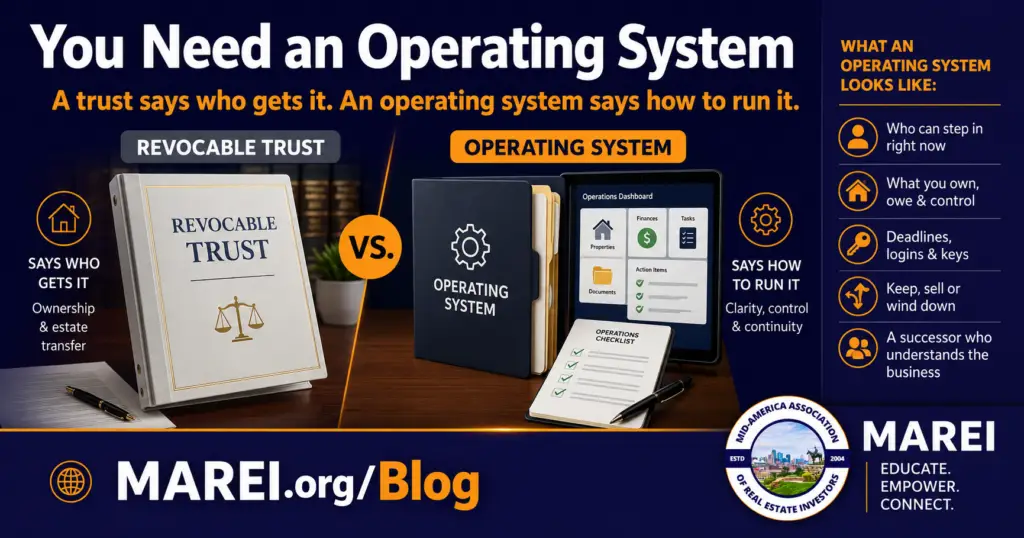
Both had real value. Both had lawyers, or easily could have. What neither had was a capable, informed successor and a set of written instructions — an operating system for the business. A will might name who inherits. A trust names who really gets things. But naming who's in charge still doesn't tell that person how to run it — and the how is where both of these estates came apart. A will and a trust are about ownership. An operating system is about operation. Most of us only ever build the first.
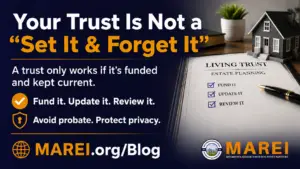
Even a perfectly funded trust — the kind we talked about last time — doesn't fix this. A trust moves ownership cleanly. It can't tell your spouse which contractor to call or which note is three payments from default.
What an operating system actually looks like
Call it your “If Something Happens to Me” file. At a minimum, it answers:
- Who can legally step in — right now. For the sudden kind, a power of attorney and a successor trustee already named, so someone can act the day of the wreck — not months later, after a court appoints a stranger. For the gradual kind, clear triggers decided while you're healthy: who takes over, and on whose say-so.
- What you own, owe, and control — every property, note, LLC, private lender, and account, in one place.
- The deadlines and the time bombs — the balloon coming due, the tax appeal, the loan that calls if the payments stop.
- Where everything lives — logins, servicers, keys, and the modern trap nobody thinks about: two-factor authentication that can lock your own family out.
- Which properties to keep, sell, or wind down — your judgment, written down, so your successor isn't guessing in the dark.
- A named successor who actually understands the business — and the conversation had out loud, while you still can.
That last one is the whole game. The gradual story teaches the hardest lesson of all: the plan only works if you're willing to let someone use it before you think you need them to.
Two events that could save your family a fortune
📅 September 8 · MAREI Meeting
The Legal Side
Estate attorney Rebecca Auriemma and CPA Dan Marlow on trusts, probate, and the tax moves that protect your heirs.
Register →📅 September 12 · Live Zoom
The Operating System
Robert Mohon's workshop: “How to Die Right as a Real Estate Investor — and What to Do If You Don't Die, But Can't Run the Business.” Start building your “If Something Happens to Me” file.
Register →Building wealth and keeping it through a death or an illness are two different skills. The second one lives or dies on the plan — and that plan is worth more than any single property you own.
Not legal or tax advice — it's the push to go get some. Case studies credited to MAREI and to Vena Jones-Cox (her father's story).

Estate Planning
Join us at the September 8th 2026 MAREI Meeting or find the replay in the Member Library. And join us at the September 12, 2026 Master Class or ask for access to purchase the replay.