Estimated reading time: 1 minute
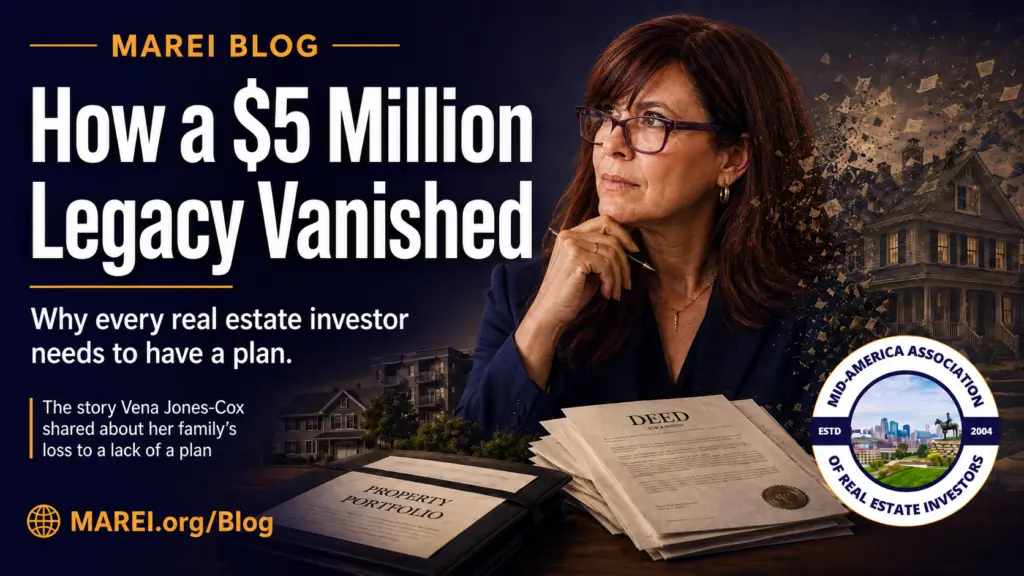
A real estate legend built a fortune over 40 years. Alzheimer's — and the absence of one plan — undid almost all of it.
By Vena Jones-Cox · shared by MAREI
A note from MAREI — This first appeared as a Facebook post from our friend Vena Jones-Cox — and it hit such a nerve that hundreds of investors replied with their own stories in the comments (you'll find some of them at the end). We asked if we could republish it here. It's about her own father: a self-made real estate millionaire who lost almost everything he'd built — not to a market crash, but to Alzheimer's and the absence of one plan. It's the clearest case we've seen for why every real estate investor needs an incapacity plan. Please, read it.
Trigger warning, both for length and for discussion of the financial effects of dementia.
My father should have died worth something like $5 million.
Instead, he died owning two houses with a combined value of less than $200,000, with almost no cash in the bank, and living mostly off social security.
Dad was a sort of real estate pioneer. He was smart, a millionaire back when a million dollars was real money, founded — or inspired the founding of — Cincinnati REIA and at least 3 other groups in the state, and the teacher of what was probably the most popular real estate investing class in Southern Ohio. His identity was VERY tied up in real estate, proving that the apple doesn't fall far from the tree, I guess.
Through DECADES (he bought his first apartment building in 1964 and his last rental house around 2004) of work and sacrifice, he built a portfolio of about 100 apartments and 150 single-family houses.
And then he got Alzheimer's.
Long before the official diagnosis, we could all see that something was wrong with his executive function.
A roof would leak, and he would spend weeks waffling about whether it needed to be repaired or replaced, making one decision on Monday and counteracting it on Tuesday.
Properties sat vacant longer and longer and deteriorated further and further. The manager of one of his apartment buildings essentially stopped managing it, leaving a heavily mortgaged building with a broken boiler and only two tenants in 13 units — one of whom wasn't paying… and month after month, that never got dealt with.
Dad knew, at least off and on, what needed to be done. But thanks to his rapidly-declining brain, he couldn't make himself do it.
And why didn't his family step in? Because his entire identity was so wrapped up in being the brilliant real estate expert and self-made millionaire that he became fiercely protective of his right to keep running the business. Even after he understood that he had Alzheimer's, he wouldn't let his children — several of whom had worked in his business over the years — step in and fix things.
By the time my mother was able to get guardianship, the real estate market was collapsing. Properties that could have been sold for a profit, even vacant and in bad condition, in 2005 or 2006 were now underwater. The vacancy was around 30%. There wasn't enough cash flow to make repairs or save everything.
And my mother saw all the problems, but couldn't handle them, either. She didn't know how to manage the properties, get them occupied, choose which ones to save, or hire the right people. She didn't know that she should call an agent instead of selling valuable properties to wholesalers. She was the wrong person to be in charge of a big real estate portfolio AND a rapidly-declining husband of 40 years.
Dad knew all of that. But Dad could no longer help her.
Over the next several years, properties were lost to foreclosure and tax sales. To prevent other foreclosures, she sold many of the best assets — including all three apartment buildings — while some of the worst ones remained. She got over a million from those sales, but that cash was quickly eaten up in taxes, judgments, and vain efforts to save other assets that weren't worth saving. Their own home eventually went into foreclosure, too.
This wasn't because he didn't know how to invest. It was because he never made a plan for EXACTLY what would happen when he could no longer be the person who knew everything, decided everything, and ran everything.
This is the exact conversation we're making room for this September at MAREI — twice. Tuesday, Sept 8 (the legal & tax plan) and Saturday, Sept 12 (the operating manual your family could actually follow). (The Sept 12 workshop is offered through MAREI and about a dozen other REIAs — join virtually here, or check with your own group.)
See Both EventsIf my father had understood what was happening, he would have been horrified. He had spent his life building wealth that made his depression-era brain feel safe, and that should have left his widow financially secure and given his five children an extraordinary legacy. Instead, my mother ended up living rent-free in a house owned by one of her children, and the estate my father had sacrificed so much to build was almost completely gone.
In a perfect world, he would have WRITTEN DOWN what my mother should do if he were gone — physically or, as it turned out, mentally — to most quickly, effectively, and profitably get that giant portfolio down to the 50 paid-off units that would have let her spend her final years doing whatever she wanted, wherever she wanted, with whomever she wanted.
We had never had the necessary conversation with him while he was healthy, even though his own mother had suffered from dementia. And it wasn't our job to bring up or solve the potential future health problems of our father. It was his.
That conversation needed to happen decades earlier — not after the symptoms appeared.
Why Every Real Estate Investor Needs an Incapacity Plan
And that's why I want every real estate investor — and the person who may someday have to take over their affairs — to attend the How to Die Right as a Real Estate Investor online workshop on September 12th.
It's half a day about getting your stuff together, so that if, God forbid, something happens to you, your heirs can easily access what you have and know what to do about it.
You have assets that your heirs probably don't even understand, much less know how to deal with, and this class will get you ready to have these conversations and lay out these plans NOW, before it's too late to preserve what you've created.
Because building generational wealth isn't enough to pass on generational wealth. You also need a plan that makes sure your family can preserve it when you're no longer able to tell them what to do.
What Other Investors Said
Vena's story struck a nerve. Dozens of investors replied with their own — and many added lessons worth as much as the story itself.
Kathy B. showed what doing it looks like: "We've moved everything — 30 doors — into a trust. With a signature, or the order of two doctors, my daughter steps in as trustee and controls the trust that owns the properties. Our big debate now is revocable versus irrevocable — because, like Vena's dad, we're just not ready to give up control just yet."
Elizabeth P. found the gift in a scare: "The best thing that ever happened to my dad was being given six weeks to live. He had very little in order. The twist? The cancer didn't kill him — he lived nine more years, and by the time he died, everything was in order and we kids were trained. Now I'm doing it for our own kids, even though we're young and healthy. It's worth it."
Then Jeff C. — who recently lost his wife unexpectedly — named the part almost no one plans for: "No amount of traditional estate planning prepares you to be the one who lives. I'd planned for a lot. Had I died instead of her, it would have been 1,000× harder — she wasn't active in the business and wouldn't have known what to do with it all. You have to plan to be the one that lives."
Kathy F. knows the false comfort of paperwork: "My dad spent a lot of money on a big binder full of paper — then did little with it for over ten years, thinking he was protecting the legacy. As the eldest and the trusted one, I'm still cleaning up the burden."
Samuel C. reminded everyone it isn't only about age: "It doesn't even take old age. At any age, a car crash, a fall, or head trauma can permanently alter your capacity."
Timothy J., 57, is simplifying on purpose: "I'm already moving from real estate toward dividends my wife won't have to manage. The biggest problem with long-time landlords is they're too scared to learn a new skill — real estate isn't truly passive; it requires management."
And Christine S. flagged the very modern trap: "Two-factor authentication codes go to phones or emails that are locked or no longer in use — so people who think they're organized can't even get into the accounts."
Different families, different assets, one conclusion: the plan is the part almost everyone skips — and the part that decides everything.
From MAREI: Vena's father never got to have that conversation while he still could. You can. This September, we've built two chances to have it — Tuesday, September 8 (MAREI Monthly Meeting with Rebecca Auriemma & Dan Marlow — the legal and tax side, in person in Overland Park) and Saturday, September 12 (the How to Die Right Master Class with Robert Mohon — the operating manual your family could actually follow). You can join the Sept 12 workshop virtually through MAREI — but MAREI is just one of about a dozen REIA groups hosting it, so if you belong to another group, check whether yours is offering it too and support your home REIA. Building generational wealth isn't the same as passing it on. The plan is what makes the difference.
Learn More & Reserve Your Spot
Vena Jones-Cox
Vena Jones-Cox has been a full-time real estate investor for more than 30 years and is one of the industry's most respected educators. Known as "The Real Estate Goddess," she leads the Central Ohio Real Estate Entrepreneurs (COREE) and teaches investors across the country.
Shared on MAREI.org with permission.