You've probably been told the key to building wealth is finding the right investment. Pick the right asset, get a strong return, be patient. Repeat.
George Antone thinks that advice is exactly backwards — and he can show you the math that proves it.
George recently sat down with Scott Ellsworth on Real Life Real Estate Investing for a 42-minute conversation that may change the way you think about money. Listen below, then keep reading for the main takeaways.
George Antone on Real Life Real Estate Investing — Growing Wealth — May 27, 2026
Growing Wealth with (George Antone)
Who Is George Antone?
George Antone has been investing full-time since 2001. Before that he spent years in the tech world, building financial software for companies like Microsoft and Intuit. He helped launch dozens of startups — including Total Entertainment Network, which was later acquired by Electronic Arts — and co-founded what became the world's largest network of private money lenders.
Today he runs Fynanc (pronounced "finance"), a company that helps everyday investors build wealth faster using math-based strategies — not guesswork. He has helped hundreds of investors cut years, sometimes decades, off their path to financial freedom.
He is also the author of three best-selling books:
- The Wealthy Code
- The Banker's Code
- The Debt Millionaire
If you've seen him at a REIA event before, you already know — the man makes your head spin in the best possible way. If this is your first time, the podcast above is a great place to start.
What He Talked About
Here are the big ideas from the episode, explained in plain English.
You're probably focused on the wrong thing
Most investors spend their energy asking: What should I invest in? What's the best return?
George says that's the wrong question. Chasing high returns often means your money gets stuck — tied up in an asset for years where you can't touch it or use it for anything else. Meanwhile, you keep working to save more, because that's the only way to keep investing.
The better question, he says, is: How fast can I get my money back so I can use it again?
Why a lower return can beat a higher one
Here's a simple example George walks through in the episode.
Say you invest $200,000 at 12% — but that money is locked up for 10 years. You're earning a great rate, but you can't touch the principal. It just sits there.
Now imagine you invest $200,000 at 8% — but within the first year, you're able to pull half of that money back out through a refinance or cash flow. You now have $100,000 to go invest somewhere else. Then you do it again.
The 8% return on a growing pile of money will beat the 12% return on a fixed pile. Every time. That's what George calls capital velocity — how fast your money moves, not just what rate it earns.
The three things slowing most investors down
George says almost every investor who isn't hitting their goals is stuck on one or more of these:
- Not enough savings going in. Simple but real. If you're only able to put $10,000 or $20,000 a year to work, it's hard to build momentum. George's approach helps you get more mileage out of what you already have — without needing to earn more.
- Money that's stuck. This is what he calls "trapped capital." Think about a property where you've built up $500,000 in equity but can't access it without selling. Or a 15-year mortgage you took out early in your career that's pulling cash out of your pocket every month. Or a mutual fund that's been sitting there for 15 years and is still mostly just your original contributions. That money isn't working as hard as it could be.
- Small leaks you don't notice. George calls this "financial friction." Things like borrowing money at the wrong time, using the wrong type of loan for an investment, or buying assets in the wrong order. None of these feel like big mistakes in the moment — but over 10 or 20 years, they add up to years of lost time.
The order you invest in matters more than most people realize
George used his own son as an example in this episode. His son wants to buy a home in San Francisco. The down payment would wipe out his entire savings — roughly $300,000 gone into one asset he can't easily access.
George's advice: not yet.
Not because real estate is bad. Because the timing is wrong. Early on, he says, you want to build up assets that are easy to access and borrow against if you need to. Think ETFs or similar investments you can tap quickly — assets that are stable, produce income, and that you can borrow against with reasonable terms. Once you've built that foundation, then you move into real estate — where you can use leverage to control a much bigger asset with less of your own money.
Get the order right, and you can build wealth much faster than if you just buy whatever sounds good today.
Note: George is sharing a framework for thinking about asset sequencing, not making specific investment recommendations. Every investor's situation is different. Talk to your own financial advisor, CPA, or attorney before making any investment decisions.
That compound interest chart your financial advisor loves? Read it again.
You've seen this one — the bar chart that shows a small amount of money turning into a huge pile over 30 or 40 years. Most financial advisors use it to explain why you should start saving young and stay patient.
George points out something most people miss: look at what's actually happening in years 1 through 20. It's almost entirely your own money. The big growth — the part that makes the curve look so good — doesn't really kick in until year 20 or 25.
His point: if the payoff is 20+ years away, there are better ways to put that money to work in the meantime. Like real estate, where you're using a loan to control a much larger asset from day one — and compounding on a bigger number from the start.
Can you really cut decades off your timeline?
George says yes — and he's seen it happen. Members of his program have reached their financial goals in 3 to 7 years. Not because they found a magic investment, but because they fixed the three bottlenecks above and kept their money moving.
His firm belief: there is no single asset that takes you from a 40-year plan to a 10-year plan. But fixing how you manage your capital? That can.
The one shift that changes everything
Stop asking: "What should I invest in?"
Start asking: "How can I get my money back faster so I can use it again?"
That one question, George says, opens up a completely different way of thinking about wealth — and a much faster path to getting there.
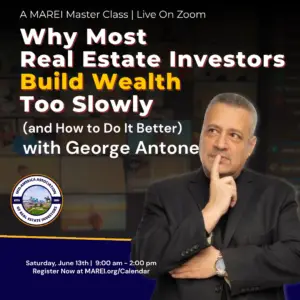
Want to Go Deeper? George Is Teaching a Full-Day Master Class for MAREI on June 13th
The podcast is a great introduction. But George is bringing the full system to MAREI on Friday, June 13th — a 5-hour deep dive on Zoom where he'll walk through the specific strategies, show you how to spot where your money is stuck right now, and give you a clear path forward based on where you are in your investing career.
Early bird pricing is available for a limited time. Full details, agenda, and registration are on the event page.
MAREI Master Class with George Antone — June 13th
Why Most Real Estate Investors Build Wealth Too Slowly — and How to Fix It
See Full Details & RegisterGeorge Antone is the founder and Chief Wealth Strategist of Fynanc, a financial technology company that helps investors reach their goals faster using math-based wealth strategies. He is the best-selling author of The Wealthy Code, The Banker's Code, and The Debt Millionaire, and co-founder of the world's largest private money lender network. He has been a full-time investor since 2001.

Real Life Real Estate
Weekly on Wednesday Afternoon.
RealLifeRealEstate.com