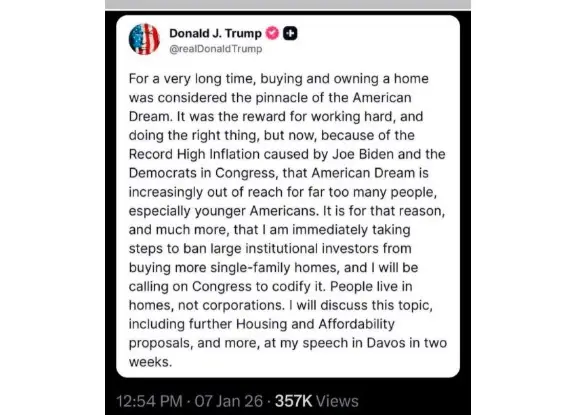
Trump says he’ll block big investors from buying more single-family homes — what we know, what we don’t, and what it could change
On Wednesday, January 7, 2026, President Donald Trump said he’s moving to ban “large institutional investors” from buying more single-family homes, and that he’ll ask Congress to codify it. His line — “People live in homes, not corporations.” — immediately lit up the housing and real estate investing world. Reuters+1
This is one of those announcements that sounds simple, but the real impact depends on the fine print: Who counts as “large”? What counts as a “single-family home” (1–4 units)? Does it include build-to-rent? What about subsidiaries? Is there a grandfather clause? None of that detail was in the initial post, and reporting so far says the administration hasn’t yet spelled out the legal mechanics. Reuters+1
Why this is suddenly a political “both sides” issue
For years, Democrats have criticized Wall Street ownership of housing and floated restrictions. What’s notable is Trump stepping into that lane with a promise of immediate action, which creates a rare moment where populist right + populist left rhetoric overlaps (even if policy details end up very different). Reuters+1
And markets noticed: single-family rental and real estate-related stocks dropped on the headline. Barron’s
The key reality: “investors” are big… but “large institutions” are usually a small slice nationally
A lot of headlines blur three different groups:
Mom-and-pop investors (small landlords, rehabbers, local LLCs – members of MAREI)
Small/medium investors (regional operators, dozens of homes – members of MAREI)
Large institutional investors (hundreds to thousands of homes, funds/REITs)
Even sources that are sympathetic to the spirit of the proposal point out the math: large institutions own a small share of total single-family housing stock nationally (often cited around ~1% depending on definition), though they can be much more noticeable in certain metros and neighborhoods. AP News+1
At the same time, broader “investor” activity (including smaller investors) can be substantial in some periods. For example, research summarized by HUD shows investor purchases spiking during the pandemic era, with big local variation, and with “large portfolio” investors playing an outsized role in that surge. HUD User
And the St. Louis Fed recently highlighted that investor-owned single-family rentals have been rising again, tying it to affordability and the rent-vs-own tradeoff (but that “investor” category is much wider than “Wall Street”). Federal Reserve Bank of St. Louis
Translation: if the policy only hits the “largest” players, the national affordability effect could be modest — but local effects could still be real in hot investor markets. MarketWatch+1
What a “ban” could actually mean in practice
Because the announcement is big but the details are thin, here are the most plausible “implementation paths” analysts are watching:
1) A narrow ban tied to federal financing or federal programs
The federal government has leverage through mortgages and housing-related rules. A policy could restrict institutional purchases in certain federally backed contexts, or create disincentives via regulation.
2) A broader statutory ban (Congress)
Trump explicitly said he wants Congress to codify it — which suggests the White House may be aiming for legislation, not just a temporary rule. Reuters+1
3) Definitions will decide who gets hit
Some recent analyses define “large investors” as 100+ single-family homes (others use 1,000+). A 100-home threshold hits more regional operators; a 1,000-home threshold mostly hits the very biggest platforms. AP News+1
4) Expect loophole-hunting unless it’s written tightly
If the rule is based on “corporations” or “institutions,” sophisticated players will try subsidiaries, partnerships, management structures, or buying through affiliates. That’s normal in regulated markets — and why enforcement language matters as much as the headline.
Would this lower prices or just shift who buys?
Here’s the honest take: it depends on the market — and on whether the policy accidentally reduces supply.
Many housing economists argue that the core affordability problem is not enough homes, and that banning one buyer class doesn’t magically create inventory. Some worry it could even reduce housing construction if institutions pull back from building or financing build-to-rent. MarketWatch+1
On the other hand, supporters argue that even if large institutions are a small national slice, in certain zip codes they may:
outbid families with speed/cash-like terms,
convert starter homes into rentals,
concentrate ownership, which can reduce consumer choice.
A 2024 GAO report summarizes the debate: institutional investors are one part of the single-family rental landscape, and research on their effects varies by geography and measurement — which is another way of saying, this isn’t a one-size-fits-all story. Government Accountability Office
What this means for local real estate investors (the “MAREI view”)
If you’re a local investor, this is the most important point:
This proposal is aimed at “large institutional investors,” not everyday investors buying a rental, doing a rehab, or acquiring a small portfolio.
But it still matters to you because it could change:
competition at entry-level price points (if big buyers retreat),
exit liquidity for rehabbers in areas where institutional buyers were a common buyer,
rentals as an asset class if institutions change how they price, build, or operate,
regulatory momentum (today it’s “large,” tomorrow the definition could drift).
The smart play right now isn’t panic. It’s watching the details and staying informed and we highly recommend learning you your legislators are and letting them know who you are and what you do, on this issue and others.
What to watch next (this is where the story becomes real)
Over the next few weeks, these are the “tells” that determine whether this is symbolic… or market-moving:
The definition of “large institutional investor” (100+? 1,000+? something else?) AP News+1
The scope: only future purchases? what about 1–4 units? build-to-rent? Government Accountability Office
Enforcement: how they prevent affiliate/subsidiary workarounds
Whether Congress actually engages (codifying is harder than posting) Reuters+1
Local variation: some markets won’t feel it; others might fastcompany.com+1

Your Government In Action
Take the time to be informed and to get to know you legislators at the city, state and federal level - and take action where appropriate.