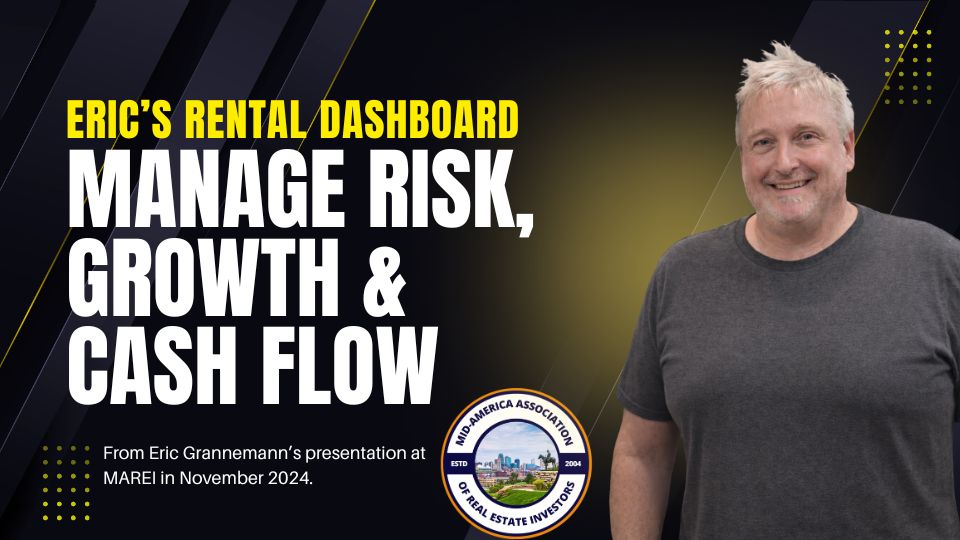
Rental Portfolio Management: How Eric Grannemann Manages Risk, Growth, and Cash Flow
Rental portfolio management is very different from simply owning a few rental properties. Most investors talk about individual houses. Eric Grannemann talks about managing the portfolio as a system.
At his last MAREI presentation, Eric shared how he got started in real estate — mistakes, slow growth, learning the hard way — but the part that resonated most with experienced landlords was what came next:
How he manages an entire rental portfolio strategically, using structure, leverage discipline, and clear performance tracking.
At the March 10th MAREI Meeting, Eric will again start with how to get started in real estate investing — and then transition into something even more valuable for those who already own rentals:
How to manage a rental portfolio using a dashboard that keeps leverage, risk, and performance visible at all times.
He’ll even apply that thinking to another investor’s portfolio live in the room.
This article previews the portfolio management portion of that conversation.
You Don’t Manage Properties One-by-One. You Manage the Portfolio.
Most landlords evaluate rentals individually:
Is this property cash flowing?
Is the rent at market?
Is the tenant stable?
Those are good questions.
But they’re incomplete.
Eric built what he calls a portfolio dashboard — a way to see all his rentals at once so he can evaluate the machine as a whole.
He explained it clearly:
“I put all my properties on a dashboard so that I can see the critical numbers that I’m looking for at the portfolio level so that I can make decisions about the portfolio.”
That shift changes everything.
A property can look fine on its own — fully rented, modestly appreciating, positive cash flow — and still be a drag if:
It ties up too much equity.
It increases rate exposure.
It weakens debt service coverage.
It blocks your ability to move into stronger assets.
It creates disproportionate management stress.
This is what disciplined rental portfolio management looks like — making decisions based on the health of the entire portfolio, not just one property.
Don’t Strip Your Rental Portfolio
During the presentation, Eric gave a clear caution:
Don’t strip your rental portfolio every two years.
He was talking about capital stripping — repeatedly refinancing properties to pull out equity and reset leverage back to 75–80% loan-to-value.
Here’s what typically happens:
You buy at 80% LTV.
Over time, rents rise.
Mortgage balances fall.
Appreciation builds equity.
Your LTV drops to 50–60%.
That’s healthy.
But if you refinance every few years and pull the equity back out, you push leverage right back up.
Then you repeat.
On paper, that feels like growth.
In reality, you remove the portfolio’s built-in safety.
Eric described it with a “marble tube” analogy. Each property enters the portfolio highly leveraged and gradually rolls toward lower leverage over time. That natural progression reduces risk and strengthens the overall structure.
If you constantly reset the clock, your rental portfolio never matures.
And when banks tighten underwriting, regulators adjust policies, or rates move unexpectedly, a highly leveraged portfolio has very little room to maneuver.
That’s the hidden risk most investors don’t see until it’s too late.
Loan-to-Value as a Strategic Tool
Eric isn’t anti-refinance. He’s intentional about leverage.
He mentioned being comfortable with portfolio leverage around 50% loan-to-value. At that level:
Banks are less nervous.
Rate increases hurt less.
Vacancies don’t create panic.
You maintain flexibility.
At 80% leverage across the board, even a small disruption can create stress.
Strong rental portfolio management means asking:
Is this refinance strengthening the machine — or just extracting liquidity?
Sometimes equity isn’t idle. Sometimes it’s your shock absorber.
Let Time Reduce Risk
Rental portfolios contain a powerful feature if you allow it to work: time.
As properties age in your portfolio:
Loan balances decline.
Rents increase.
Cash flow improves.
Equity compounds.
That gradual move from 80% LTV toward 40–50% LTV builds resilience.
Long-term investors allow that to happen.
Speculators reset leverage constantly.
Those are two very different strategies.
If you are managing a rental portfolio with a long-term mindset, your properties should become less risky over time — not more fragile.
Growth Without Structure Creates Fragility
The deeper message in Eric’s presentation wasn’t about chasing more units.
It was about structure.
You can grow aggressively while increasing risk.
Or you can grow while systematically reducing risk over time.
The difference is:
Monitoring leverage.
Watching debt service coverage.
Managing rate exposure.
Screening carefully.
Letting properties mature.
Making decisions at the portfolio level.
That’s what a portfolio dashboard enables.
And that’s what Eric will walk through in detail at the March meeting — including reviewing another investor’s rental portfolio live and discussing:
Where equity is trapped
Where leverage may be excessive
Which properties might be dragging performance
What adjustments could strengthen the overall portfolio
If you already own rentals, this session will help you move from simply owning properties to managing a rental portfolio strategically.
If you’re newer, you’ll see what long-term rental portfolio management looks like before you build it.
Join Us March 10th at the DoubleTree in Overland Park
Eric Grannemann will expand on these ideas and share real-world examples at the upcoming MAREI Meeting:
Tuesday, March 10th
5:30 PM – 8:30 PM
DoubleTree by Hilton – Overland Park
The evening includes:
✔ Networking beginning at 5:30 PM
✔ Real-world rental portfolio management strategy
✔ A live portfolio review and discussion
✔ Q&A with experienced investors
Your first meeting is free when you preregister.
Reserve your seat at:
MAREI.org/Calendar
Not yet a member? Membership starts at $25/month or $149/year at:
MAREI.org/Membership
We’ll see you March 10th.
Screening Is Portfolio Protection
Eric was clear on one non-negotiable:
If you don’t screen properly, you’ll have fires everywhere.
Tenant screening is not just about one lease.
A bad tenant can:
Disrupt cash flow.
Trigger legal costs.
Increase turnover.
Drain management energy.
Ripple across the portfolio.
Strong screening is not just property management — it’s rental portfolio risk management.
One weak decision can affect the entire machine.

Eric Grannemann
Local Kansas City Metro Real Estate Investor and Long time MAREI Member and Mentor.