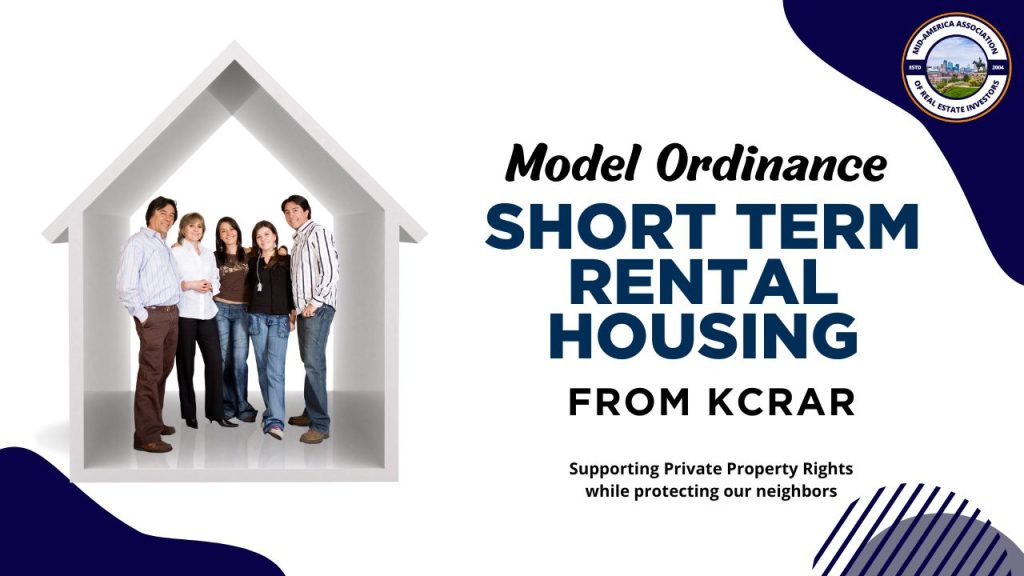
The Kansas City Regional Association of Realtors (KCRAR) has publicly released a Model Short-Term Rental (STR) Ordinance to assist cities and counties that are reviewing or developing regulations for short-term rental activity across the Kansas City region. With many jurisdictions actively evaluating how to approach STRs, this model provides a practical, well-structured framework that promotes clarity, consistency, and fairness.
It is a public document and clearly outlines the intent, structure, and protections built into the proposed policy.
It is a public document and clearly outlines the intent, structure, and protections built into the proposed policy.
Rather than approaching short-term rentals as a problem to be restricted or eliminated, the model ordinance starts from a more grounded premise: short-term rentals are a legitimate residential use that can coexist with neighborhoods when clear, reasonable standards are in place.
The ordinance was developed by KCRAR’s Public Policy Committee, informed by a recent KCRAR member poll. That process is evident throughout the document, particularly in how it balances community interests with the rights of property owners.
Thanks to everyone who did participate in the poll
Recognizing Housing Flexibility
One of the most important acknowledgements in both the ordinance and KCRAR’s advocacy messaging is that short-term rentals play a meaningful role in housing flexibility.
According to KCRAR, member feedback emphasized that STRs help provide temporary lodging for out-of-market families who are actively searching for a home, relocating for work, or navigating transitional housing needs that don’t fit neatly into traditional lease structures.
That reality matters—especially as communities work to balance housing availability, affordability, and mobility.
A Model for Thoughtful Local Policy
This is not a mandate or a one-size-fits-all solution. It is a model ordinance, intended to give cities and counties a dependable starting point—one that protects neighborhoods while also respecting lawful property use.
In a policy environment where short-term rentals are often regulated reactively, this document stands out as thoughtful, measured, and grounded in real-world data and experience.
For anyone involved in housing, investing, or local decision-making, it’s worth reading the ordinance itself and understanding what it actually proposes.
Core Principles Embedded in the Ordinance
Several key themes run consistently throughout the model ordinance:
Property Rights as a Foundation The ordinance explicitly states that regulations should use the least restrictive means necessary to protect public health and safety. It cautions against de facto bans, arbitrary caps, spacing requirements, or regulatory barriers that are not equally applied to long-term rentals.
Parity With Long-Term Rentals (LTRs) Short-term rentals are treated at parity with long-term rentals. Occupancy limits, parking rules, inspections, and enforcement standards align with existing residential rental requirements rather than imposing STR-specific restrictions.
Residential Classification STRs are clearly classified as residential uses, not commercial or industrial properties. This distinction is critical, as misclassification has often been the starting point for overly restrictive local policies.
Reasonable Registration and Safety Standards The ordinance supports registration, safety self-certification, and compliance with existing building and fire codes—without excessive fees, routine inspections, or administrative hurdles that would discourage responsible operation.
Cause-Based Enforcement Rather than blanket enforcement or complaint-driven overreach, inspections and penalties are tied to verified complaints, documented violations, and clear due process protections, including notice and cure periods.




Thanks Kim – Great summary!
its all chatgpt we just move words and copy and paste