MAREI Advocacy Update
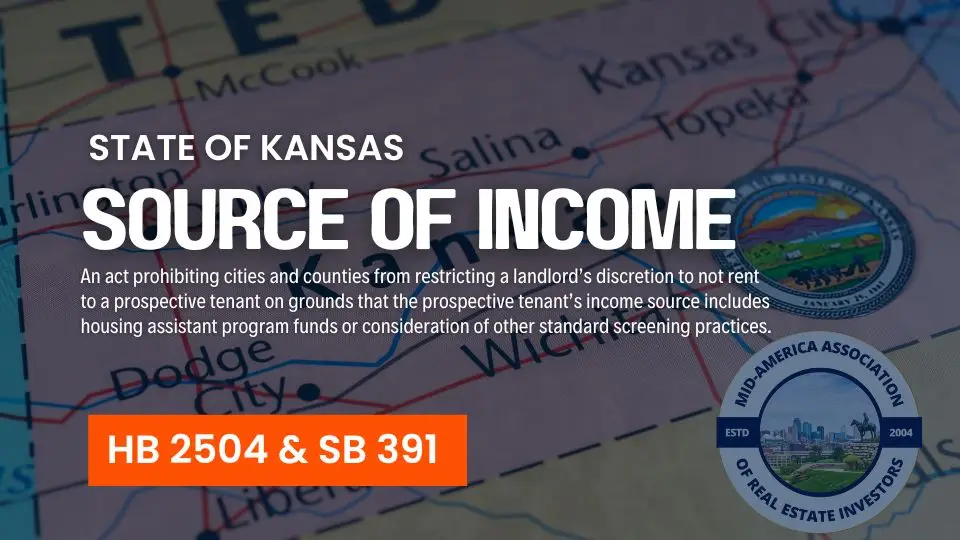
Call to Action in Support of Kansas SB 391
Please take action on this right now, today as our deadline is Wednesday and forward this to others who should also take action.
|
|
Kansas lawmakers are currently considering two closely related bills—House Bill 2504 and Senate Bill 391—that address a growing concern for housing providers, real estate investors, and local housing markets across the state.
Both bills are designed to preserve long-standing tenant screening and leasing safeguards by limiting the ability of local municipalities to mandate rental acceptance requirements that remove traditional risk-management tools used by property owners.
Ed Jaskinia of The Associated Landlords of Kansas has testified in support of both measures before the Kansas House and Senate committees. MAREI is in support of his efforts. If you see Ed, thank him for his efforts and be sure to join your local Landlord Group in Kansas, part of your dues go toward helping him with advocacy.
Ed’s Testimony on HB 2504 and SB391
What HB 2504 and SB 391 Aim to Do
At their core, HB 2504 and SB 391 seek to prevent local governments from imposing rental mandates that override standard business practices used by housing providers—including income verification, credit standards, lease terms, and other screening criteria that protect both property owners and tenants.
These bills do not eliminate fair housing protections. Instead, they reinforce the principle that:
Housing providers must comply with state and federal fair housing law
Property owners should retain the ability to evaluate risk and operate sustainable rental businesses
Local ordinances should not force owners to lease under conditions that remove essential safeguards
SB 391 is largely a reworded companion bill to HB 2504, introduced to ensure the policy path remains viable through both chambers.
Read HB 2504: see on BillTrack 50
Read SB 391: See on BillTrack 50
Why This Matters to Housing Stability
Rental housing is not sustained by mandates alone—it depends on viable operations, responsible underwriting, and long-term asset stewardship.
When local ordinances require property owners to rent without the ability to:
Verify lawful income sources
Assess financial capacity
Apply consistent lease standards
the result is often less housing availability, not more.
History shows that when risk increases without corresponding safeguards:
Small housing providers exit the market
Investment capital shifts elsewhere
Maintenance and reinvestment decline
The very tenants these policies aim to help face fewer options
A Familiar Policy Pattern: Lessons from Missouri
These Kansas bills closely mirror legislation passed in Missouri in 2025, which responded to Kansas City, Missouri’s Source of Income ordinance.
That Missouri law was designed to reassert state-level consistency and protect housing providers from fragmented local mandates that created legal uncertainty and operational risk.
👉 You can read MAREI’s analysis of the Missouri legislation and its impact on the MAREI Blog from 2025
Kansas lawmakers are now facing a similar policy crossroads.
Strong Opposition—And Why That’s Expected
Both legislative committees have indicated that organized tenant advocacy groups are strongly opposed to these bills.
That opposition is not unexpected, they have even filed their answering bills to this:
SB 485: That talks about source of income and hiding evictions (read here)
Plus several other bills listed below.
Why MAREI Is Paying Attention
As a trade association serving real estate investors and housing providers, MAREI tracks legislation that directly affects housing availability, risk management, and long-term market health.
These bills reflect a broader national conversation:
How do we expand housing access without dismantling the systems that make housing viable?
How do we protect tenants and ensure providers can continue operating responsibly?
And while you might take issue to any one of the bills listed in this article and think, “Someone should do something about this”, keep in mind that someone is you.
Get involved.
Stay informed.
And when we ask – Make that Call, Send that Email, Go Visit your Legislator
MAREI will continue to:
Monitor housing-related legislation in Kansas and Missouri
Share analysis with members
Provide context beyond headlines and talking points
If you want to stay informed about advocacy issues affecting real estate investors and housing providers, make sure you’re subscribed to MAREI updates and attending our monthly meetings where these topics are discussed in real time.
Other Tenant Advocacy Backed Bills
SB 485: That talks about source of income and hiding evictions (read here)
Plus several other bills in both the House and Senate aimed at changing Landlord Tenant Law in Kansas
House Bills
HB 2074
Homestead renters tax relief
→ Makes renters eligible for homestead property tax refunds.
HB 2099
Rental inspections tied to subsidies
→ Allows periodic inspections of subsidized rental housing.
HB 2225
Mobile home tenant protections
→ Prevents park owners from limiting tenant access to internet/video services.
HB 2357
Eviction record sealing + mediation
→ Seals eviction filings and requires mediation before eviction proceeds.
HB 2454
Income counting + partial payments
→ Requires landlords to count certain income and accept partial rent payments.
HB 2634
Default maintenance code
→ Imposes a state maintenance code where local codes don’t exist.
HB 2665
Tenant termination rights
→ Expands tenant ability to terminate leases for landlord noncompliance.
HB 2666
Late fee restrictions + disclosures
→ Limits late fees and adds required tenant disclosures.
HB 2667
Tenant right of first refusal
→ Requires landlords to offer properties to tenants before selling publicly.
HB 2690
Interior inspections without consent
→ Allows administrative interior inspections under certain conditions.
HB 2691
Cause-based eviction
→ Requires cause for eviction and changes eviction procedures.
Senate Bills
SB 100
Fair Chance Housing Act
→ Limits use of eviction history and rental debt in tenant screening.
SB 369
Late fee caps + disclosures
→ Senate version of late fee limits and disclosure mandates.
SB 370
Tenant termination for landlord breach
→ Expands tenant rights to terminate leases.
SB 371
Tenant purchase priority
→ Senate version of tenant right of first refusal.
SB 388
Maximum late fees
→ Sets a statutory cap on late rent fees.
SB 415
Consumer Protection Act penalties
→ Makes landlord-tenant violations subject to KCPA enforcement.
SB 416
Interior inspections without consent
→ Senate version of administrative inspection authority.
SB 443
Cause-based eviction
→ Senate version requiring cause for eviction.
SB 444
Expanded interior inspections
→ Allows cities/counties to inspect interiors and abate violations.
SB 455
Homestead renter tax refunds
→ Senate version of renter tax relief.
SB 466
Old eviction record limits
→ Restricts use of older eviction or rental arrears records.
SB 482
Security deposit refunds
→ Requires return of deposits and rent when units are condemned.
SB 485
Income mandates + eviction sealing + mediation
→ Requires income counting, seals and expunges eviction records, mandates mediation, and adds KCPA penalties.

Advocacy
Other current issues to review