Let’s clear something up first:
 LLCs are not the problem Entities absolutely matter
But the way they’re being sold?
That’s where things break down.
A lot of investors are getting guidance from people who:
- Sell entity packages
- Promote multi-layer strategies
- Push “advanced” structures
Not from people who actually:
- Defend lawsuits
- Fix broken setups
- Or see what happens when things go wrong
And that difference matters.
If someone’s business is selling:
- LLC setups
- Trust structures
- Multi-state strategies
Then what are they going to recommend?
More entities More layers More complexity
Even when it’s not necessary.
And according to Hyre, that’s exactly what’s happening.
Many of these structures:
- Solve problems most investors don’t have
- Ignore the risks investors actually face
- And create systems that are harder to manage correctly
Here’s what most people don’t realize:
Asset protection doesn’t get tested when you set it up It gets tested when everything goes wrong
That means:
- There’s a lawsuit
- You don’t settle
- A judgment is entered
- And someone is trying to collect
That’s when your structure has to hold.
And overly complex setups?
They often fail because:
- They weren’t maintained properly
- They weren’t understood by the owner
- Or they created inconsistencies that can be challenged
Hyre emphasizes this over and over:
Forming entities is easy. Maintaining them is where people fail.
Even with the right entity…
That’s not what protects you.
What protects you is what you do with it.
Things like:
- Keeping finances separate
- Documenting decisions
- Handling deals correctly
- Following basic operational discipline
Hyre even describes asset protection as partly a “narrative”—
The story your records tell if you ever end up in front of a judge.
And most investors?
They never build that story.
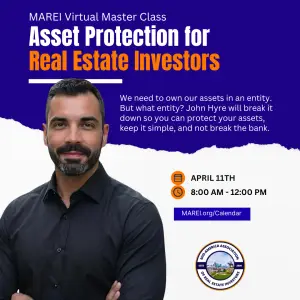
That’s exactly what John Hyre is teaching in this upcoming workshop.
In about 4 hours, he’ll walk you through:
- What you actually need to set up
- What you can ignore
- And what you must do when buying and selling properties to make it all work
So you can build asset protection that:
 Works in real life Doesn’t cost a fortune And is simple enough to manage yourself
You can grab all the details and save your seat for the April 11th Virtual Master Class Here. It’s 8 am to Noon Central on Zoom. It is recorded. You will get the replay.