(Before You Ever Need an LLC to Save You)
When real estate investors think about asset protection, they usually jump straight to LLCs and corporations.
And yes—those matter.
But here’s the problem:
Most investors focus on entities… and ignore everything that actually prevents lawsuits in the first place.
That’s backwards.
Ask anyone who’s attended a John Hyre Asset Protection Class and they will tell you what John will tell you:
“If you want real protection, you don’t start with entities.
You start by making sure you don’t get sued—or lose—at all.”
So we took a look at a past article John Shared with us many year ago and what held then is still true Now:
1) Entities Are Your Last Line of Defense
LLCs don’t protect you from getting sued.
They only matter after everything has already gone wrong.
For an entity to actually “protect” you, this has to happen:
- You get sued
- The case isn’t dismissed
- You don’t settle
- You lose in court
- Your insurance doesn’t cover it
Only then does the LLC step in.
Think about that.
If your plan starts with entities, your strategy begins at the worst-case scenario.
A better approach:
👉 Focus on not getting to that point in the first place.
2) What Actually Gets Investors Sued
Most lawsuits against real estate investors fall into three buckets:
- Contract disputes
- Negligence
- Deceptive or unfair business practices
If you handle these well, you dramatically reduce your risk.
3) Contracts: Where Most Problems Start
Bad contracts (or no contracts) are one of the biggest causes of lawsuits.
What to fix immediately:
✔ Stop using generic contracts
Free contracts are worth exactly what you paid for them.
If you’re serious about investing, your contracts should be reviewed by a real attorney.
✔ Don’t rely on handshake deals
Partnerships fall apart. It’s not “if,” it’s “when.”
Operating agreements are there to solve problems before they happen.
✔ Don’t be greedy in your terms
Yes—contracts should favor you.
But if they’re too one-sided, a judge can throw them out.
✔ Keep contracts simple and clear
If someone can argue they didn’t understand it—and the court agrees—you’ve got a problem.
👉 Simple, clear, fair (but favorable) wins.
Tip: We have some great attorney’s here at MAREI. Hire them to help you draft the right contract for what you are doing, that few $100 now will save you $1,000s later on. We promise!
4) Negligence: The Lawsuit You Didn’t See Coming
Example: A tenant slips and falls.
Are you liable?
It depends.
Negligence usually comes down to:
- Did you maintain the property reasonably?
- Did you know (or should you have known) about the issue?
What smart investors do:
✔ Know your state laws
What’s required isn’t always obvious—and it varies.
✔ Document everything
If a tenant says, “I told you about that,” can you prove otherwise?
✔ Inspect common areas regularly
Courts often assume you should know about issues in shared spaces.
👉 If it’s not documented, it didn’t happen.
5) Deceptive & Unfair Practices: Where Investors Get Burned
This is where things get dangerous—especially with creative deals.
Every state has laws against:
- Deceptive practices
- Unfair business practices
And the definitions are broad.
How to protect yourself:
✔ Be extremely clear in your deals
Spell out:
- What’s happening
- Who benefits
- What the risks are
Especially when working with:
- Distressed sellers
- Foreclosures
- Creative financing
✔ Use plain-language summaries (disclaimers)
If someone doesn’t understand the deal, you’re exposed.
✔ Avoid “too good for you” deal structures
If it feels like:
“Heads I win, tails you lose…”
…it will likely feel that way to a judge or jury too.
👉 You don’t lose lawsuits because of clever structures.
You lose because someone thinks you were unfair.
Aside: There seems to be a HUGE case brought by the Kansas Attorney General for violating this section and no LLC of any kind is going to help the investor out.
6) Insurance: Your Real Safety Net
Insurance is not optional.
And it’s not the same as your LLC.
What to do:
✔ Carry real liability coverage
Think $1M+—enough to encourage settlement.
✔ Understand what’s NOT covered
Common exclusions:
✔ Cover the right people and entities
Make sure everything is properly named and protected.
👉 Insurance handles the big hits.
Everything else helps you avoid them.
Note we have some great insurance companies in the Business Directory, be sure to use them.
The Real Bottom Line
If you want to protect your assets:
Don’t start with entities.
Start with:
- Strong, clear contracts
- Ethical, balanced deal structures
- Proper documentation
- Understanding your legal responsibilities
- Solid insurance coverage
Do that well, and:
- You’re less likely to get sued
- More likely to settle if you are
- More likely to win if it goes to court
Then—and only then—does your LLC step in as backup.
So do I even Need an LLC?
At this point, you might be thinking:
“So… do I even need an LLC?”
Yes. You do.
But you need to do that right too – it’s not just register with the state and you’re good. You also don’t need to fork over $1,000 for some complicated structure. What do you need?
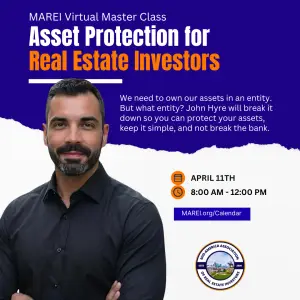
Well we recommend you start with John Hyre’s Master Class on April 11. Its from 8 to Noon and if you’re a MAREI Member and sign up early, it’s only $47 to attend AND get the replay. It will be the BEST $47 you ever spend on getting your business set up correctly . . . that is if you attend or at least watch the replay.