Here’s what we know so far
Take Action Against SB 415 by 8 am Monday 3/16
Kansas has a meeting Monday 3/16 – please take action ASAP if you live in Kansas or have properties in Kansas.
Please look up your Kansas Senator for the property address you own and address your email to them.
Look up your legislator here: look up here
Sample Email 1 from Stacey Johnson Cosby: read sample here
Kansas has a meeting Monday 3/16 – please take action ASAP if you live in Kansas or have properties in Kansas.
Please look up your Kansas Senator for the property address you own and address your email to them.
Subject: Please Vote NO on SB 415
Dear Senator [Last Name],
I am writing as a Kansas housing provider ( and / or a resident of Kansas) to respectfully ask you to vote NO on SB 415.
Everyone agrees that tenants deserve safe, habitable housing. Kansas law already requires that, and there are already remedies in place when landlords fail to meet those standards.
However, SB 415 goes much further than enforcing existing law.
The bill would pull landlord-tenant disputes into the Kansas Consumer Protection Act (KCPA) by treating landlords as “suppliers” and tenants as “consumers.” The KCPA was designed to address consumer fraud—not the operational realities of rental housing.
This change would expose housing providers, including small landlords, to expanded liability, investigations, and potentially severe penalties even in situations where repairs are being actively managed.
Kansas already has habitability protections in place, including:
• K.S.A. 58-2553, which outlines landlord responsibilities
• K.S.A. 58-2559, which provides tenant remedies
• The implied warranty of habitability recognized by Kansas courts
The issue is not the lack of law. The issue is consistent enforcement of the laws already on the books.
SB 415 risks creating:
• More legal uncertainty for housing providers
• Higher operating costs and insurance risks
• Reduced investment in rental housing
• Fewer housing options for Kansas renters
Many rental homes in Kansas are owned by small housing providers, not large corporations. Policies that dramatically increase liability can unintentionally push responsible providers out of the market.
If dangerous housing conditions occur, local governments already have tools to address them through inspection, code enforcement, nuisance procedures, and condemnation authority.
Expanding statewide liability under the KCPA will not fix enforcement gaps and may instead make Kansas a more difficult place to provide rental housing.
For these reasons, I respectfully ask that you vote NO on SB 415 and instead focus on strengthening enforcement of existing housing laws.
Thank you for your time and service to Kansas.
Sincerely,
[Name]
[City], Kansas
[Housing provider / real estate investor / landlord]
Kansas SB 415: What the Bill Does — and Why Many Housing Providers Oppose It
Kansas lawmakers are currently considering Senate Bill 415 (SB 415), a proposal that would change how certain landlord-tenant disputes are handled in the state.
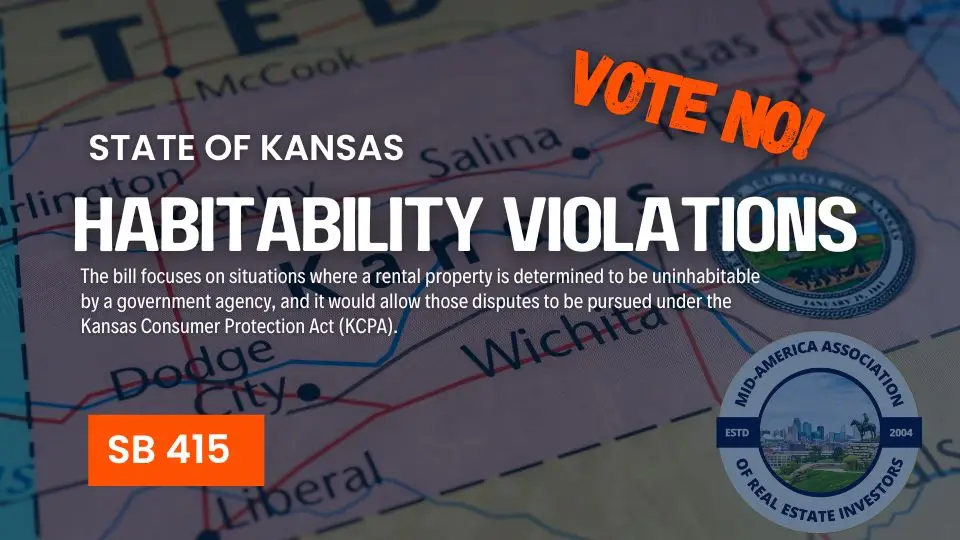
The bill focuses on situations where a rental property is determined to be uninhabitable by a government agency, and it would allow those disputes to be pursued under the Kansas Consumer Protection Act (KCPA).
Supporters argue this gives tenants stronger enforcement tools.
However, many housing providers, property owners, and real estate organizations believe the bill could create serious unintended consequences for the Kansas housing market.
Understanding both what the bill does and why there is opposition helps clarify the policy debate.
What SB 415 Would Do
SB 415 proposes to amend the Kansas Residential Landlord and Tenant Act.
Under the bill, if a landlord:
Causes or fails to correct a condition
That condition leads a government agency to declare a unit uninhabitable
And the landlord fails to take reasonable corrective action after notice
then the tenant could pursue remedies under the Kansas Consumer Protection Act (KCPA).
The bill would also:
Define the landlord as a “supplier”
Define the tenant as a “consumer”
Remove the need to prove a traditional consumer transaction
That change is significant because the KCPA carries stronger penalties and enforcement mechanisms than traditional landlord-tenant remedies.
You can review the official bill here:
Kansas Legislature SB 415
https://kslegislature.gov/li/b2025_26/measures/sb415/
Why Many Housing Providers Oppose SB 415
While everyone agrees unsafe housing should be addressed, many housing providers believe SB 415 takes the wrong approach and could create unintended consequences for Kansas housing.
Kansas Already Has Habitability Laws
Kansas law already requires landlords to maintain safe housing and gives tenants remedies when serious violations occur.
For example:
• K.S.A. 58-2553 outlines landlord duties
• K.S.A. 58-2559 provides tenant remedies
Kansas courts also recognize an implied warranty of habitability, meaning landlords must maintain basic health and safety standards.
The concern raised by housing providers is that the issue is often enforcement of existing laws, not the absence of legal tools.
Expanding the Kansas Consumer Protection Act
The most controversial part of SB 415 is that it would apply the Kansas Consumer Protection Act (KCPA) to certain landlord-tenant disputes.
The KCPA was designed to address consumer fraud and deceptive business practices. Under SB 415, a landlord could be treated as a “supplier” and a tenant as a “consumer,” allowing disputes over habitability to be pursued under consumer protection law.
Housing providers argue this dramatically expands legal liability beyond what landlord-tenant law currently allows.
More Risk and Uncertainty for Housing Providers
Critics say the bill could introduce vague standards such as “constructive notice” and “reasonable corrective action.”
Because rental housing involves coordinating repairs, vendors, inspections, and tenant access, these standards could create uncertainty about when liability applies.
Opponents warn this may lead to:
• Increased legal exposure
• Higher operating costs
• Reduced willingness to invest in rental housing
Potential Impact on Housing Supply
Many rental properties in Kansas are owned by small housing providers, not large corporations.
When regulatory risk increases, owners often respond by tightening screening standards, delaying investments, or leaving the rental market altogether.
Housing providers worry this could ultimately reduce rental supply and increase housing costs.
Most housing providers support strong enforcement against landlords who knowingly allow unsafe conditions.
However, critics argue SB 415 is overly broad and duplicative of existing law, and that better enforcement of current housing standards may be a more effective solution.

Advocacy
The latest issues facing housing providers in Kansas and Missouri