When most people talk about making money in real estate, they usually mean one thing:
monthly cash flow.
But talk to Eric Grannemann a local MAREI Mentor and he will tell you that cash flow is only one of several ways real estate quietly builds wealth over time. In fact, many of the biggest gains don’t show up month to month at all — they show up years later, when decisions compound.
He spoke a while back at MAREI and we took some notes. This article outlines what we learned.
Eric didn’t start out with some grand plan. His first property took a year just to make livable, and in hindsight, he’ll tell you he would have been better off putting that money into a different deal. But that experience became the foundation for how he evaluates property and portfolios today.
Here are the core ways he outlined that real estate creates wealth — often simultaneously.
1. You Make Money When You Buy
One of the earliest lessons Eric shared is that value is often created before you ever collect rent.
He told the story of an older owner who casually asked if Eric wanted to buy his property after a long-term tenant moved out and left decades’ worth of belongings behind. The seller didn’t want a rehab project or a long closing process — he wanted out.
The price dropped quickly. Eric didn’t go to a bank. He structured owner financing, put the seller on autopay, and bought the property over time. Years later, that same property was sold at a significant gain as part of a larger package.
The lesson wasn’t clever negotiation — it was recognizing motivation and being willing to buy when the deal made sense, not when the market was exciting.
2. Renovation Isn’t Just Cosmetic — It’s Strategic
Eric shared several before-and-after examples where renovation wasn’t about flipping, but about repositioning.
In one case, a property with a hoarding tenant rented for $1,200 per month. After renovation, the rent doubled. The improvements paid for themselves not just once, but every year after.
He also pointed out something many investors overlook: when you eventually sell, you often get back the renovation money and a premium for the improved condition.
Renovation, when done intentionally, increases rent, improves tenant quality, and strengthens long-term returns — not just short-term value.
3. Cash Flow Improves Over Time
Cash flow matters, but Eric was clear: it usually doesn’t show up all at once.
Early on, properties may cash flow modestly — or barely at all — especially when leverage is involved. But over time, rents rise, loans amortize, refinances reset payments, and the same property behaves very differently five or ten years later.
This is why Eric cautioned against judging deals only by year-one numbers. The slope matters more than the snapshot.
4. Mortgage Paydown Is Quiet Wealth
One of the simplest — and most overlooked — wealth builders is mortgage paydown.
Every rent payment reduces principal. Over time, tenants quietly convert debt into equity. Eric illustrated how a property purchased with 20% down can turn into 75% equity over a decade, even in a “normal” appreciation environment.
That equity isn’t just theoretical — it creates options. It lowers risk. It gives flexibility when markets change.
5. Appreciation Isn’t Speculation — It’s Inflation Working for You
Eric made a point that resonated with many in the room:
When a property doubles in price over ten years, it didn’t necessarily “go up” — the dollar went down.
The real power comes from leverage. When inflation erodes the value of debt while the asset value rises, equity growth accelerates. This is how real estate quietly outperforms many traditional investments without needing perfect timing.
6. Repositioning Changes the Game
Some of Eric’s favorite examples involved repositioning.
He talked about:
- Splitting duplexes and selling units separately
- Adding bedrooms or bathrooms to change rental dynamics
- Converting long-term rentals into different use cases
- Changing how properties are managed or financed
In each case, the property didn’t change location — its function changed. That shift created new value without buying something new.
7. Taxes Matter More Than Most People Think
Eric didn’t sugarcoat taxes — he dislikes paying them as much as anyone.
Real estate offers depreciation, interest deductions, cost segregation, and — in certain households — the ability to use real estate professional status to offset other income.
He also shared strategies involving hiring children in the business, paying them legitimately, and using earned income to fund long-term tax-advantaged growth — not as tricks, but as planning.
8. 1031 Exchanges Tie It All Together
If there was a favorite tool in the room, it was the 1031 exchange.
Eric walked through how exchanging allows investors to:
- Defer capital gains
- Move equity into larger or easier-to-manage assets
- Consolidate multiple properties into one
- Shift asset classes entirely
He shared how a portfolio evolved from small residential properties into larger multifamily holdings — not by starting over, but by rolling equity forward over time.
And eventually, through stepped-up basis, that deferred tax burden can disappear entirely.
The Bigger Point
The real takeaway from Eric’s presentation wasn’t that you need to master every strategy.
It was this:
Real estate wealth is layered.
Different properties do different jobs at different times. Some produce cash. Some build equity. Some create tax benefits. The investors who succeed long-term are the ones who step back periodically, look at the whole picture, and make intentional decisions.
That’s why portfolio evaluation — not just deal acquisition — becomes so important as you grow.
And it’s why this conversation keeps coming up at MAREI.
Want to learn more from Eric?
Take the time to watch his past presentation at MAREI.org/EricOne
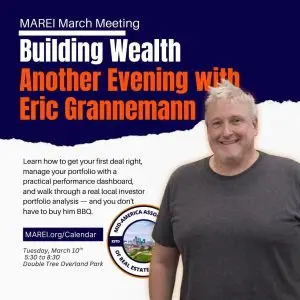
Join us at the March 10th MAREI Meeting where he has his follow up presentation starting with how to get started with your first deal and then after you have a few deals how to manage your numbers using a simple dashboard or spreadsheet to see your over all performance and how to evaluate and improve that performance.
Join us at the April MAREI Meeting for Mentor Night when we will have Eric available to take questions.
And we really think if the concept of managing a rental portfolio is where you are at in your real estate investor learning cycle that you may find our Master Class on March 28th on how to buy the right properties at the right prices, with the right financing, then manage them systematically and profitably as you scale.
Last our Members Only 7 Week Series . . the Money & Markets Playbook to learn how Capital, Credit, Policy and Psychology Shape Wealth. Starts February 15th.

Eric Grannemann
Real Estate Investor and MAREI Mentor.